Recruiter Admin Time: Where the Hours Actually Go, and What Automatic Capture Removes
A candidate's history lives across five channels. The record holds whichever one the recruiter remembered to log. Here is what that costs and what automatic capture has to produce to fix it.
Take one candidate from first contact to submission and count the touches. Outreach on LinkedIn. Reply to email. Scheduling over WhatsApp. A screening call on the phone. A follow-up voice note. Five channels, one person, and a candidate record that reflects whichever of the five the recruiter remembered to write down. Recruiter admin time is not a discipline problem. It is a re-entry tax on information the system already saw.
Key takeaways
- The cost is minutes per candidate, not hours per week. Individually each logging task takes two to four minutes. Multiplied by throughput it becomes a headcount question.
- Channel fragmentation is the root cause. WhatsApp, email, LinkedIn and phone each hold part of the story, and the record holds none of it in full.
- A transcript on the record is storage, not capture. If a recruiter still has to read the call to know what happened, the work moved rather than disappeared.
- The test is Monday morning. Can a delivery manager see the true state of a desk without asking anyone? If not, your status meeting is compensating for a logging failure.
Where recruiter admin time actually goes
Not in one large block. In dozens of small ones, which is why it is invisible in a calendar and obvious in a P&L.
Log the outreach. Note the reply. Write up the screening call. Update the stage. Copy the notice period into a field. Forward the CV. Write the submission summary. Update the client tracker. Chase the follow-up. Note that the follow-up happened.
Ten tasks, two to four minutes each. On a desk running twenty candidates a week, that is most of a working day spent transcribing things that already happened.
The second cost is worse and harder to see. Every one of those tasks is a context switch away from the work that produces revenue, and the recovery cost of a switch is larger than the task itself.
Why the candidate record is never current
Because the conversation is not in one place, and no amount of process discipline changes that.
The initial outreach went on LinkedIn because that is where the profile was. The reply came to email because that is what was in the signature. Scheduling happened on WhatsApp because that is what the candidate actually checks. The screening was a phone call. The follow-up was a voice note.
When a colleague picks up that candidate for a different role six months later, they start from a record missing four fifths of the history. So they ask the same questions again, and the candidate notices.
The India channel problem
Most recruitment software was designed around email as the primary candidate channel. On an India desk, that assumption is wrong on day one.
Candidates reply on WhatsApp. They read email eventually and reply to WhatsApp immediately. A phone call from an unknown number often goes unanswered, then gets returned over WhatsApp twenty minutes later. The conversation that decides the placement happens on the channel your ATS most likely cannot see.
The consequence is structural rather than annoying. If the primary channel is not threaded into the record, then the record is not a record. It is a partial archive of the least important conversations, and every judgement made from it is made on incomplete information.
Two practical tests for any system you are evaluating. Can a delivery manager read a WhatsApp thread on a candidate record without asking the recruiter for a screenshot? And when that recruiter leaves, does the thread stay with the firm or leave on their phone?
The second question is the one owners tend not to ask until it is too late.
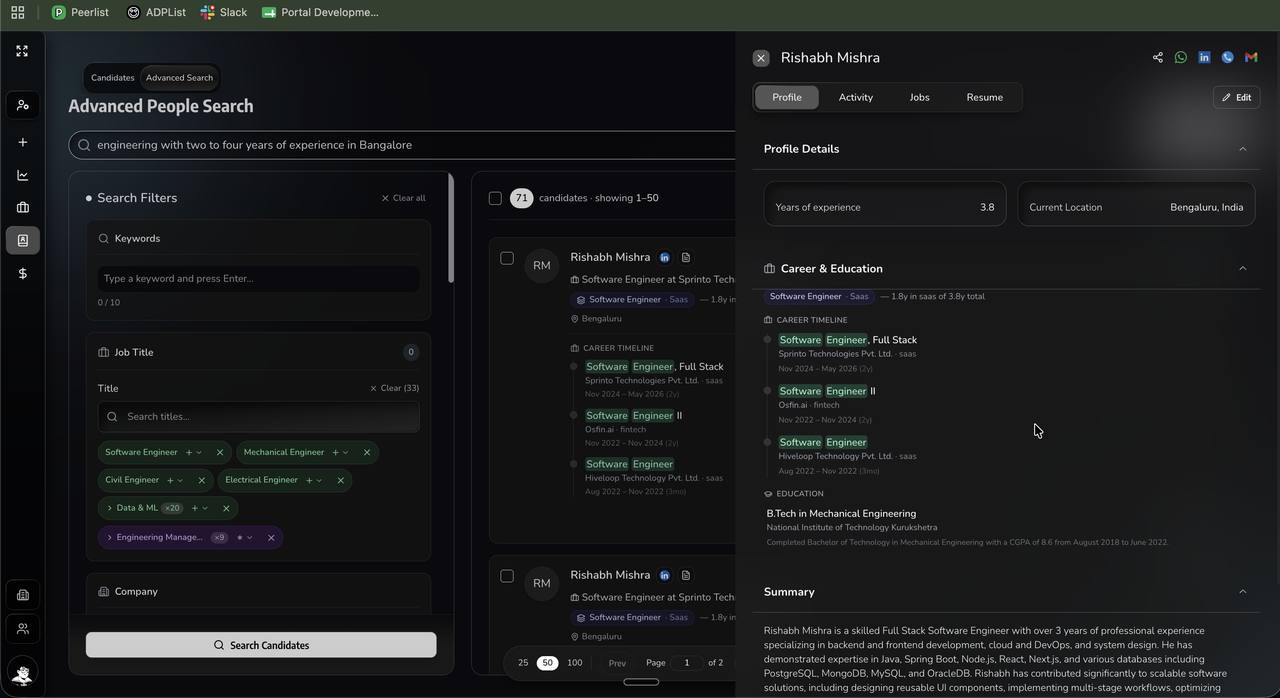
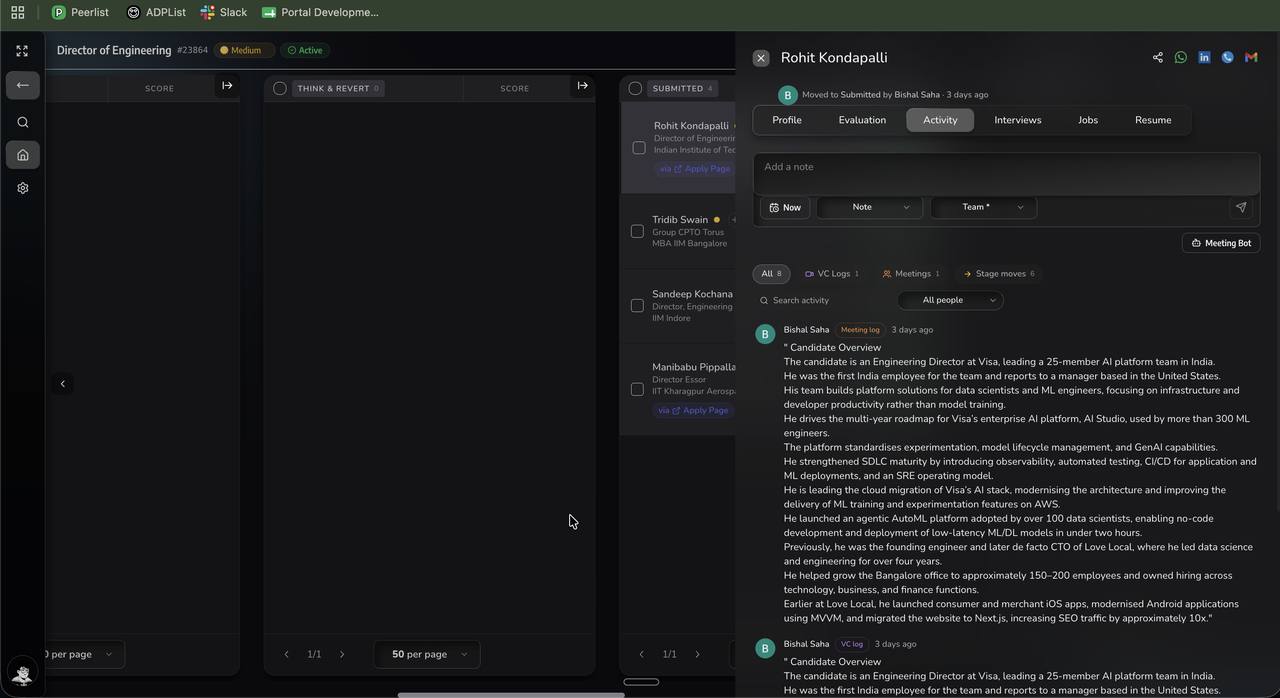
What automatic capture has to produce
Not a transcript. Structure.
| Channel | Captured automatically | What it should become |
|---|---|---|
| Phone and AI call | Recording, transcript | Extracted fields, summary, flagged contradictions, next actions |
| Full thread | Threaded to the person, with stated availability extracted | |
| Sent and received, attachments | Threaded, with CV versions filed against the candidate | |
| Outreach and replies | Merged into the same single timeline | |
| Meetings and video | Recording, participants | Written summary with the stage move attached |
The test is fifteen seconds. A recruiter who has never spoken to this candidate should be able to read the record and know exactly where things stand. If they have to open a transcript, the extraction is not good enough.
The minute-by-minute cost of one candidate
Abstract percentages do not move anyone. A single candidate does.
| Task | Typical time | Removed by capture? |
|---|---|---|
| Log the outreach attempt | 2 min | Yes |
| Note the reply and its content | 2 min | Yes |
| Write up the screening call | 6 min | Yes |
| Copy notice period and CTC into fields | 2 min | Yes |
| Update the pipeline stage | 1 min | Yes |
| Write the submission summary | 8 min | Partly, it still needs judgement |
| Update the client tracker | 3 min | Yes |
| Chase and log the follow-up | 3 min | Yes |
Roughly 27 minutes per candidate, of which around 19 exist only because the system did not write down what it already observed. On a desk touching twenty candidates a week, that is more than six hours.
Six hours is not a productivity statistic. It is most of a submission day, and in contingency work the firm that submits first usually gets paid.
What to check when evaluating capture tooling
Most tools in this category demo well and disappoint in week three. Five questions separate them.
Does it thread, or does it store?
Ask to see one candidate who has been contacted on three channels. If the record shows three separate logs rather than one timeline, it is storing, not threading.
What does it extract, not just record?
Ask which fields populate automatically after a call. If the answer is a transcript and a summary, a human is still doing the data entry, just later.
Does WhatsApp actually work, or is it a roadmap item?
In India this is the whole game. Ask to see a live WhatsApp thread on a candidate record, not a slide about it.
What happens when the same person exists twice?
Capture into a database with no matching creates three records holding a third of the history each. Ask what happens at the point of entry, not at cleanup.
Who can see it?
Threaded history is only useful if the colleague who picks up the candidate next quarter can read it. Check the permission model before you check the capture.
What changes for a delivery manager
The weekly desk review is where the cost of bad logging becomes visible.
When records are maintained by hand, the review is a status update. Each recruiter reports what they remember, in a favourable light, and the manager takes notes. Nothing is verifiable and nothing gets diagnosed. The meeting exists to reconstruct information the system should already hold.
When capture is automatic, the activity is already visible before anyone sits down. The meeting can then be about blockers, which is the conversation that changes an outcome. Same thirty minutes, entirely different use.
This is also where the value of a maintained database compounds. Every logged conversation is a signal on a record that a future search will surface.
Consent and recording rules
Automatic capture of calls sits inside a real regulatory frame, and it is worth knowing where you stand before you switch it on across a team.
Recording consent rules differ across India, individual US states and the EU. Several jurisdictions require disclosure before recording begins rather than afterwards. The EU AI Act adds obligations where AI systems are used in recruitment, and the GDPR and India's DPDP Act both govern what you then hold.
The practical rule: the requirement follows the candidate's location, not your office's. If your desks place across borders, the strictest applicable standard is the one to build to. We cover the specifics in the AI screening call guide.
Where automatic notes do not help
Worth stating plainly, because a tool sold as fixing everything fixes nothing.
It does not fix a recruiter who is not making calls. Automation makes activity visible, which some teams find uncomfortable. That visibility is a management problem before it is a software one, and the software will not have the conversation for you.
It does not fix a bad brief. Perfectly logged conversations about the wrong requirement are still the wrong requirement. That is a scorecard problem, upstream of this one.
It does not remove judgement. What the notes buy is more time to exercise it, which is only worth something if the recruiter has judgement worth exercising.
What good looks like after three months
The change is not that recruiters do less typing. It is that three things become possible which were not possible before.
A candidate can be picked up by anyone
Six months after a conversation, a different recruiter opens the record and knows what was discussed, what the person wanted, and why they did not move. They do not re-ask questions the candidate has already answered, which is the single most common complaint candidates make about agencies.
A desk can be reviewed without a meeting
Activity is visible before anyone sits down. The weekly review becomes a conversation about blockers instead of a reconstruction exercise, and it gets shorter.
Departures stop being data loss
When a recruiter leaves a firm that logs manually, their desk history leaves with them. Some of it was in their head, most of it was on their phone. With capture, the firm keeps the relationship history even when it loses the relationship holder.
That last one is the argument that lands with owners, and it rarely appears in a demo because it is invisible until the day it matters.
Frequently asked questions
How much time do recruiters spend on admin?
Industry reporting consistently puts non-recruiting work at the majority of a recruiter's week, covering data entry, logging calls, updating stages and rebuilding context. The only number that matters for your firm is the one you measure on your own team, which takes one unannounced day of time tracking across three recruiters.
What is automated call logging in a recruitment CRM?
It captures conversations across phone, email, WhatsApp and LinkedIn and writes them onto the candidate record without anyone typing. The useful version extracts structured fields such as notice period and compensation, rather than only storing a transcript that somebody still has to read.
What is the difference between a transcript and structured capture?
A transcript is the words that were said. Structured capture pulls the facts out of those words into fields that can be searched, filtered and reported on. Only the second one saves time, because a transcript on a record still requires a human to read it before the record is usable.
Does automated call logging require candidate consent?
Recording consent rules vary by jurisdiction. India, several US states and the EU all impose requirements, and some require disclosure before recording begins. If your desks place across borders, the requirement is set by the candidate's location rather than your office's.
Why is WhatsApp integration important for recruitment in India?
In India, WhatsApp is often the primary channel candidates actually reply on. A system that does not thread WhatsApp into the candidate record will always hold an incomplete history, because the most current part of the conversation sits on an individual recruiter's phone.
What should a delivery manager be able to see without asking anyone?
The true state of every desk: which candidates were contacted, what they said, which submissions are live and where each one is stuck. If that requires a status meeting to establish, the logging is not working and the meeting is compensating for it.
How to measure your own admin load
Ask three recruiters to log every minute of one full day, split into two columns: recruiting and not recruiting. Do it once, unannounced, and do not use it punitively. Announce it afterwards, not before, or you will measure their best day rather than a normal one.
The result is usually uncomfortable and it is the only number that will make the case internally. Everything else in this post is argument. That is evidence.
See one candidate record built entirely from automatic capture
Bring a live candidate and a week of history. We will show you what lands on the record when nobody types anything.
Book a demoFounder of Sortinghat, an AI-native ATS and CRM for staffing, search and RPO firms. Writes about recruiter capacity, sourcing economics and what actually changes when AI reaches a delivery desk. More about the author
Related reading
Talent Pool Software: How to Rank Your Own Database Before You Pay a Job Portal
WorkflowAI Screening Calls: What Gets Asked, Verified and Written to the Record
WorkflowHiring Scorecards: How to Turn a Job Description Into Weighted Evaluation Criteria
GlobalOffshore Recruitment Delivery: Time Zones, Handoffs and What Travels