What Clients Actually Pay Agencies For Now That AI Does the Sourcing
The honest question every staffing founder should be able to answer in one sentence, and most cannot.
A client with modern tooling can search, contact and schedule without you. So the question that decides your fee is no longer whether you can find people. It is what you do that the client's own team cannot do cheaply, and there are only four defensible answers. Firms that cannot name which one applies to them are negotiating on rate whether or not they realise it.
Last reviewed July 2026. Observations from Sortinghat customer delivery, stated as directional.
Key takeaways
- Access is no longer a defensible fee. Clients have tooling, data and search. Having found somebody is not worth what it was.
- Verification is the strongest remaining answer. Establishing that a claim holds is expensive for a client and cheap for a specialist.
- Speed is defensible only if it is genuine. In contingency work the firm that submits first usually gets paid, but speed is easy to claim and easy to check.
- Risk transfer is underused. Guarantees, replacement terms and accountability are things an internal team cannot offer itself.

Access, and why it stopped working
The original agency proposition was reach. You knew people the client did not, held a database the client could not build, and had time the client did not have.
Each of those has eroded. Candidate information is broadly available, tooling is cheap, and search no longer requires a specialist skill. A client asking what you do that they cannot is asking a reasonable question, and capacity is not a satisfying answer at a fifteen percent fee.
This is the source of most fee pressure, and it does not resolve by explaining the value of relationships.
Verification
The strongest remaining answer, and the least well marketed.
Finding fifty plausible candidates is cheap. Establishing which five can actually do the job is not, because it requires domain knowledge, a structured conversation and the willingness to ask a second question when an answer is vague.
The claims that fail most often are quantified impact figures on a CV. Candidates state a percentage improvement or a revenue movement, and under questioning about baseline, period and personal contribution, some of them do not hold. Catching that costs four minutes. A client catching it at their own technical interview costs a slot and some credibility.
An agency that can describe its screening standard specifically is selling something. One that says it screens thoroughly is not.
Speed, when it is real
In contingency and RPO, the firm that submits first usually gets paid. That is a genuine commercial value and it is worth a fee.
The problem is that every agency claims it and clients can measure it. If your average brief-to-shortlist is eight days and you are selling urgency, the claim collapses on the first mandate.
A recruiter running manual screening manages around 40 calls a day and finds three or four people worth submitting. Filtering before contacting produces roughly 10 submission-ready profiles in hours. That is a defensible speed claim because it is structural rather than effort-based.
Market knowledge and risk transfer
Market knowledge. Telling a client that their band is below market, that the skill combination exists in forty people nationally, or that the location constraint is costing six weeks is worth more than a shortlist. It is also the thing most likely to earn exclusivity.
Risk transfer. An internal team cannot offer itself a replacement guarantee. An agency can, and it is chronically underused as a commercial lever because firms treat it as a concession rather than as the product.
What this means for how you price
If your answer is access, expect continued fee compression and plan for it.
If it is verification, price on difficulty rather than salary. A role that is hard to verify supports a fee that a role anybody could fill does not, and percentage-of-salary pricing captures none of that difference.
If it is speed, guarantee it contractually. A commitment that carries a consequence is worth several times a claim that does not.
If it is knowledge, sell the diagnosis before the shortlist. That is a different first meeting and it usually produces a different fee conversation.
What this changes on a staffing desk
Market analysis is only useful if it changes something on Monday. Four practical consequences that follow from everything above.
Your prospect list is probably built from history
Most staffing firms sell to the accounts they already know, which means the client list reflects where demand was five years ago rather than where it is now. Rebuilding a prospect list against current hiring activity rather than past relationships is unglamorous and it is usually the highest-return week a founder can spend.
Speed matters more than it used to
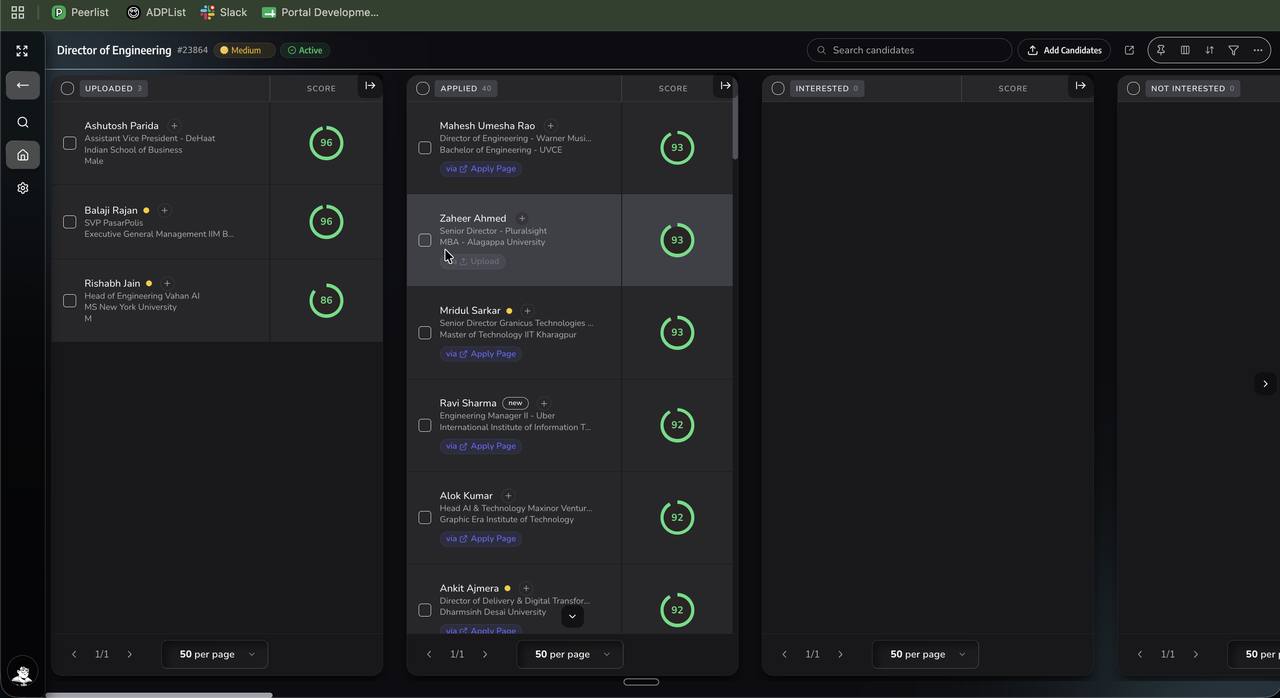
In contingency and RPO, the firm that submits first usually gets paid. A recruiter working manually manages around 40 calls a day and finds three or four people worth submitting. Filtering before dialling changes that arithmetic: a pool search on a volume role surfaces around 1,200 relevant profiles, narrows to a ranked 300 contacted across call, WhatsApp and email in parallel, and produces roughly 10 submission-ready profiles in hours.
Your own database is the cheapest source you have
An audit of one firm's 3 million records found roughly 10 percent duplicates, 10 percent unusable and 80 percent real people whose records were simply out of date. Making that 80 percent findable took job portal spend from about $100 a role to $60. Most firms are paying to source strangers while sitting on people who already know them.
Definition beats effort
Most wasted submissions are a briefing failure that surfaced three weeks later, not a sourcing failure. Generating weighted evaluation criteria from the job description, and agreeing them with the client before the search starts, removes more waste than any increase in activity.
Frequently asked questions
Why are clients pushing back on agency fees?
Because the original proposition was access to people and information they could not reach, and that has largely eroded. Clients now have tooling, data and search, so a fee justified by having found somebody is harder to defend.
What can a staffing agency do that a client's internal team cannot?
Four things: verify capability at a standard the client cannot cheaply replicate, submit faster in a structural rather than effortful way, bring market knowledge the client does not have, and carry replacement risk that an internal team cannot offer itself.
How should staffing agencies price now?
On difficulty rather than salary where the value is verification, contractually where the value is speed, and by selling the market diagnosis before the shortlist where the value is knowledge. Percentage-of-salary captures none of these differences.
Is speed still a valid agency differentiator?
Only when it is structural. Every agency claims speed and clients measure it. Filtering before contacting produces roughly ten submission-ready profiles in hours, which is defensible; working harder at manual screening is not.
What is the most underused agency value lever?
Risk transfer. An internal talent team cannot offer itself a replacement guarantee, and most agencies treat guarantees as a commercial concession rather than as a core part of what they are selling.
How do you justify a fee to a client with good internal recruiting?
By naming what you verify that they cannot, and showing the standard. A client with a capable internal team usually has a capacity problem rather than a capability one, which is a different and easier conversation.
The sentence worth writing down
Write one sentence describing what your firm does that the client's internal team cannot do cheaply. Not what you do well, what they cannot do.
If it takes more than a sentence, or if the honest version is capacity, that is your commercial position and it explains every fee conversation you have had this year.
See the screening standard behind a submission
Bring a role and we will show you what gets verified before a candidate reaches a client.
Book a demoFounder of Sortinghat, an AI-native ATS and CRM for staffing, search and RPO firms. Writes about recruiter capacity, sourcing economics and what actually changes when AI reaches a delivery desk. More about the author
Related reading
Pay Transparency Laws and What They Change for Staffing Agencies
Product Comparison 101Sortinghat vs Tracker RMS: The 2026 Comparison for UK and Global Agencies
GlobalGlobal Recruitment Fee Structures: How Agencies Charge by Market
Product Comparison 101ATS Pricing in 2026: What Staffing Firms Actually Pay