High Volume Recruiting: What One Screening Day Actually Produces
A recruiter makes about 40 calls a day and finds 3 or 4 people worth submitting. Here is what changes when the pool is filtered first, and where the approach stops working.
High volume recruiting has a hard ceiling, and it is not dialling speed. A recruiter working a full calling day makes around 40 calls and, on a good day, finds 3 or 4 people worth submitting. The other 36 conversations were spent discovering that someone was not eligible, not available, or not interested. That discovery is the work, and it is the part that does not scale.
Key takeaways
- 40 calls produces 3 to 4 submissions on a good day. That is the realistic human ceiling, and it is limited by qualification, not by effort.
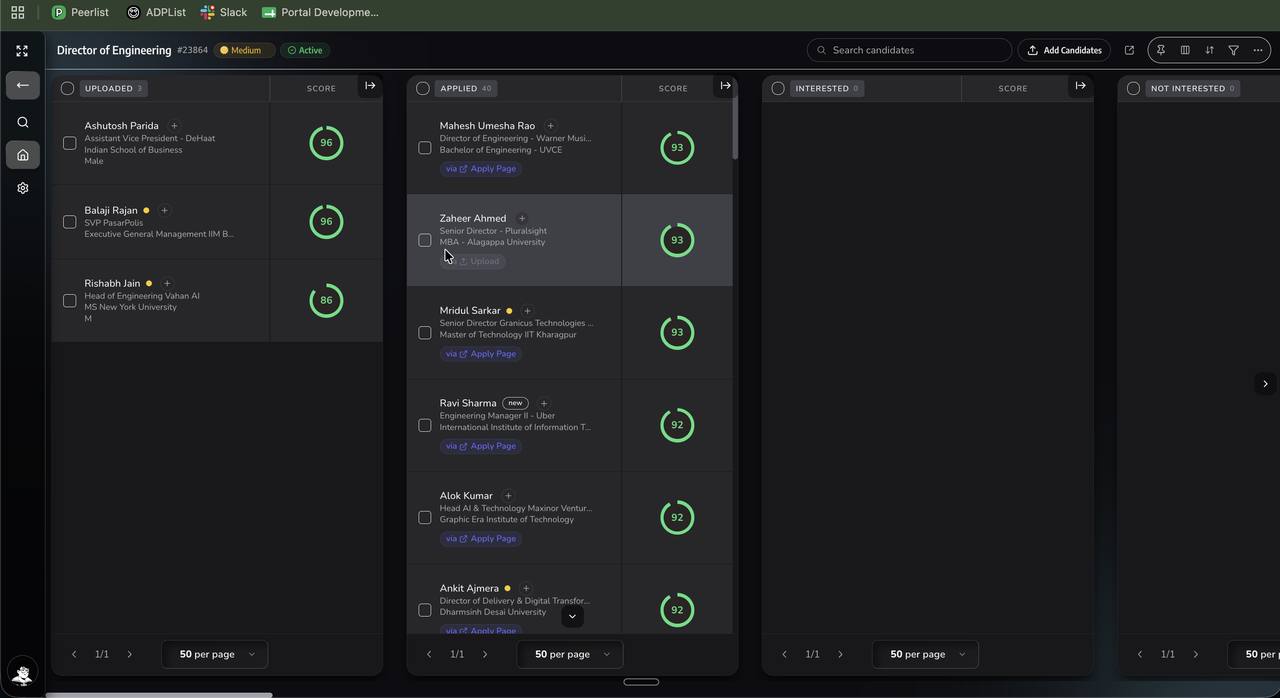
- Filtering before calling changes the arithmetic. In our delivery, a pool search returning around 1,200 relevant profiles narrows to a top 300 who are contacted in parallel, producing roughly 10 submission-ready profiles in a few hours.
- Volume scales with the pool, not the process. On a high-volume QA role we submitted 120 profiles in one day. On a niche senior role the same process produces four.
- The output is a shortlist, not a screening count. A day that produces 300 completed conversations and four usable candidates was a bad day with impressive activity metrics.
The 40-call day, and why it caps out
Watch where a manual calling day actually goes.
The recruiter starts from a list, usually pulled fresh from a job portal that morning. They dial. Most calls do not connect. Of those that do, a large share end within ninety seconds because the person has moved role, is not looking, is outside the salary band, or is in the wrong location.
The conversations that matter are the handful where the person is eligible and interested. Those take ten to fifteen minutes and they are the only ones producing anything. The other 36 calls were a filter being applied one person at a time, by the most expensive resource in the building.
You cannot fix this by dialling faster. Adding calls adds unqualified conversations in the same proportion, which is why headcount has historically been the only lever in high volume recruiting.
What changes when you filter before you dial
The alternative is to spend the filtering effort before the calling starts, not during it.
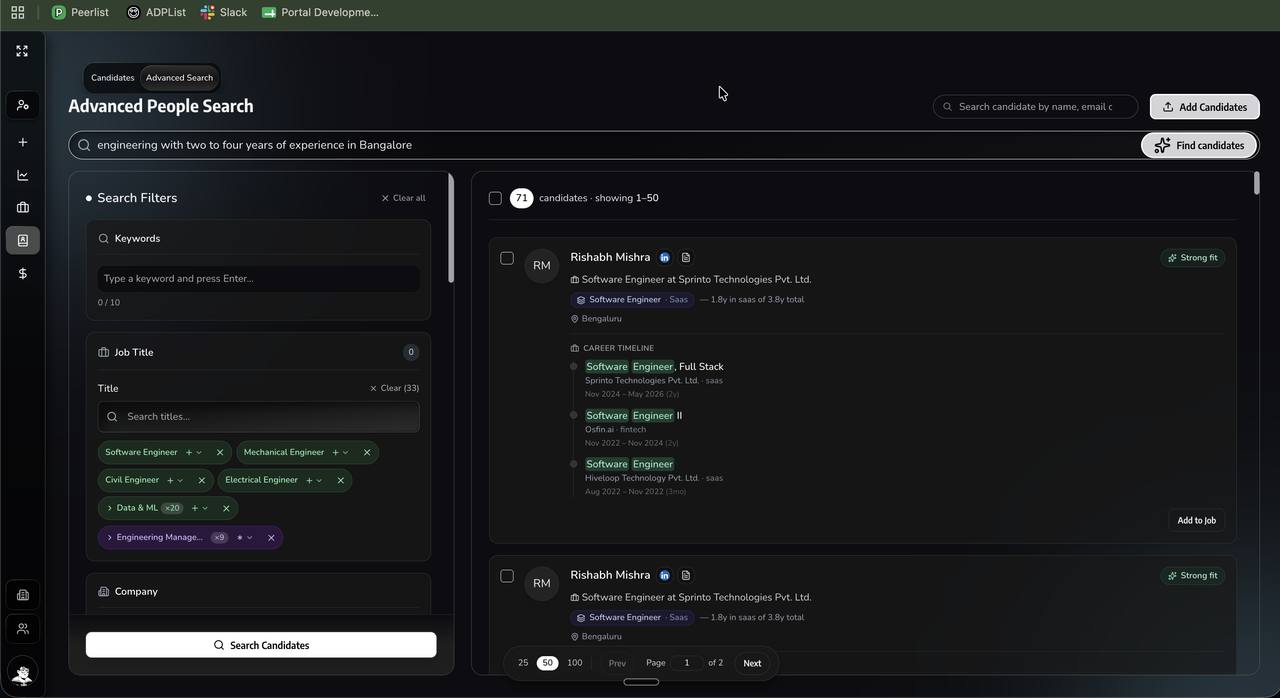
A search across the firm's own pool returns the profiles that plausibly match, and how many depends entirely on the depth of that pool. In our delivery, a typical volume role surfaces around 1,200 relevant profiles. Those get ranked against the role's criteria, and the top 300 are contacted by call, email and WhatsApp in parallel rather than in sequence.
The output within a few hours is roughly 10 submission-ready profiles, each with availability, compensation expectation and the role-specific claims already confirmed.
The important number there is not 300. It is that the 300 were chosen before anyone spoke to them, which is what makes the conversation rate worth having.
Where the 1,200 comes from
The number that decides the day is the one the search returns, so it is worth understanding what drives it.
It is not a measure of how good the search is. It is a measure of how much relevant history your firm has accumulated in that skill area, which is a different thing entirely and cannot be bought.
Depth by vertical, not overall
A firm with 500,000 records is not uniformly deep. It is deep in the two or three verticals it has worked for years and shallow everywhere else. Volume recruiting works brilliantly in the deep areas and not at all in the shallow ones, and the average across the database tells you nothing useful.
Reachability, not record count
A profile with a dead phone number is not in the 1,200 in any meaningful sense. What matters is how many of those matching records can actually be contacted today, which for most firms is materially fewer than the raw count suggests.
Recency of the availability signal
A candidate whose notice period you confirmed last month is worth ten whose situation you last checked in 2023. The pool that produces good days is the one that has been worked, not the one that has been stored.
The parallel contact decision
The other structural change is contacting people across channels simultaneously rather than one after another.
The sequential approach is a call, then an email two days later if nothing came back, then a WhatsApp message after that. It is polite and it costs a week. On a role where the client is also briefing two other agencies, a week is the whole race.
Parallel contact compresses that to hours. The trade-off is real and worth naming: someone who would have replied to the first message now receives three, which on a badly targeted list is annoying. That is why the filtering has to happen first. Parallel contact on a precise segment is efficient. Parallel contact on a broad list is spam with better tooling.
Why the numbers move so much by role
Anyone quoting a single throughput figure for high volume recruiting is selling something. The number is a function of two things, and both are outside the process.
Pool depth
A search only returns what your database holds. A firm that has placed QA engineers for six years has a deep pool for QA and almost nothing for actuarial. The same process produces 1,200 candidates for one and 40 for the other.
Criteria width
A role requiring three years of manual testing in Bangalore has a wide funnel. A role requiring reinforcement learning experience plus India site leadership has a narrow one, and no amount of parallel calling widens it.
This is why our own results range from 4 submissions on a niche senior search to 120 profiles submitted in a single day on a high-volume QA requirement. Same platform, same method, entirely different arithmetic.
| Stage | Manual day | Filtered day |
|---|---|---|
| Source of the list | Fresh portal pull that morning | Ranked search across your own pool |
| People contacted | 40 dialled | ~300, across call, email and WhatsApp |
| Filtering happens | During the call, one at a time | Before the call, against the criteria |
| Recruiter's job that day | Dialling | Triage and the conversations that need selling |
| Typical output | 3 to 4 submissions | ~10 in a few hours, more on wide roles |
| Where manual still wins | Senior, confidential and relationship-led searches | The first call is a qualification, not a sell |
What the recruiter is doing on a filtered day
Not dialling. Reading, deciding and moving people.
Results arrive continuously. Each one is a small decision: advance, reject, flag for a human call, or return to the pool with a reason. A recruiter working well does this in under a minute per result.
The failure mode is a recruiter who starts reading full transcripts. That turns triage into review, and throughput collapses by mid-morning. If transcripts are being read, the structured extraction is not good enough, and that is a system problem to fix rather than a discipline problem to shout about. We cover what should land on the record in the screening call guide.
The second thing they are doing is taking the calls that need a person. A strong candidate on a competitive role needs selling, not qualifying, and that conversation should never be automated.
What actually reaches the client
This is where most volume operations go wrong.
Three hundred conversations do not produce three hundred submissions. They produce a shortlist, and on a normal role that shortlist is in single or low double digits. Each profile carries evidence: what was verified, what the candidate said, what the real notice period is, and where a CV claim did not hold up.
Everything else is not waste. It is a segmented, freshly confirmed pool that becomes the warmest list you own for the next role on that desk. That compounding is the actual return, and it does not appear in any single day's numbers.
The metrics that mislead on a volume desk
Volume recruiting generates impressive-looking numbers, and most of them are worthless as management signals.
| Metric | Why it misleads | Use instead |
|---|---|---|
| Calls or contacts made | Rises whenever the bar is lowered | Evidenced submissions produced |
| Profiles sourced | Most were never viable | Profiles contacted from a ranked list |
| Screening completion count | Measures tolerance, not fit | Contact-to-submission ratio |
| Total submissions | Rewards volume over accuracy | Submission-to-interview ratio |
The pairing rule: never review a volume metric without the conversion metric next to it. Three hundred contacts and ten submissions is a good day. Three hundred contacts and forty submissions, of which two get interviewed, is a bad day that will look excellent in a weekly report.
When high volume recruiting is the wrong approach
Three situations where this makes things worse rather than better.
Senior and confidential searches. The first conversation is persuasion, not qualification. Running it at volume signals that the role is not worth a person's time, and the candidates you want are the ones who notice.
A badly defined brief. Screening 300 people against the wrong criteria is a faster route to the wrong answer, and the speed makes it worse. Fix the scorecard before you scale the process.
A shallow pool. If the search returns 40 profiles rather than 1,200, you are not doing volume recruiting. You are doing normal recruiting with extra software, and the honest move is to say so.
Candidate experience at 300 contacts
The objection to volume outreach is that it treats people as a list. It is a fair objection and the answer is not to dismiss it.
Three things separate a filtered day from a spray. The contact is relevant, because the person genuinely matches the role. The message says why them specifically. And the process discloses what it is at the start rather than after the fact.
Do those three and 300 contacts performs better than 40 unfiltered calls, because 300 relevant people are less annoyed than 40 irrelevant ones. Skip them and you have industrialised something that was already unpopular.
The measurable version is your opt-out rate. If it climbs when volume climbs, the targeting is wrong, not the volume.
Frequently asked questions
How many calls can a recruiter make in a day?
Around 40 on a full calling day, which on a good day converts to 3 or 4 candidates worth submitting. The ceiling is not dialling speed. It is that most of those 40 were never viable, and the recruiter finds that out one conversation at a time.
How many candidates can be screened in a day with AI calling?
In our own delivery, a filtered shortlist of roughly 300 people is contacted by call, email and WhatsApp in parallel, producing around 10 submission-ready profiles within a few hours. On a high-volume QA role we submitted 120 profiles in a single day, because the pool was deep and the criteria were wide.
What roles suit high volume recruiting?
Roles with clear, checkable eligibility criteria and a deep candidate pool. Volume QA, support, sales development and entry to mid engineering all work. Senior, confidential and executive searches do not, because the first conversation is a sell rather than a qualification.
Does volume screening hurt candidate experience?
It depends entirely on relevance and disclosure. A well-targeted call that respects someone's time performs better than a recruiter leaving 300 voicemails. A poorly targeted one at scale is worse than doing nothing, because you have annoyed 300 people instead of 40.
How many profiles should you submit per role?
Fewer than you can. Volume screening should produce a small evidenced shortlist, not a large list of everyone who passed. The exception is genuine high-volume hiring, where the client is filling many seats and wants breadth.
What happens to candidates who do not make the shortlist?
They return to the pool with a logged reason and freshly confirmed availability. That segment is the warmest list you own for the next similar role, which is the compounding argument for working your own database first.
How to run your first filtered day
Pick a role you have filled before, so you already know what a good candidate looks like. Run the search against your own pool and note how many profiles come back. That number is your ceiling for the day, and it tells you more about your database than about your process.
Then measure the only thing that matters: evidenced submissions produced, and how much of the pool came back with confirmed availability. Do not measure calls made.
See a filtered screening day on your own pool
Bring one role you are working now. We will run the search, show you the depth of your own pool, and build the shortlist against your criteria.
Book a demoFounder of Sortinghat, an AI-native ATS and CRM for staffing, search and RPO firms. Writes about recruiter capacity, sourcing economics and what actually changes when AI reaches a delivery desk. More about the author
Related reading
AI Screening Calls: What Gets Asked, Verified and Written to the Record
BenchmarksCandidate Response Rates by Channel: Call, WhatsApp and Email Compared
Talent PoolTalent Pool Software: How to Rank Your Own Database Before You Pay a Job Portal
AnalyticsStaffing KPIs: The Four Numbers a Firm Owner Should Check Every Day