Candidate Response Rates by Channel: Call, WhatsApp and Email Compared
Out of 100 candidates contacted for a strong role: about 40 respond to a call, 25 on WhatsApp, and 12 to 15 by email. Here is what that means for how you sequence outreach.
The candidate response rate on a phone call is roughly three times the rate on email. In our own outreach, out of every 100 people contacted about a well-paid role with genuine prospects, around 40 respond to a call, about 25 respond on WhatsApp, and 12 to 15 reply to an email. Most recruitment sequences are built in exactly the wrong order.
Key takeaways
- The phone still wins, by a wide margin. Around 40 responses per 100 contacted, against 25 on WhatsApp and 12 to 15 by email.
- These are ceiling numbers, not averages. They are measured on roles with strong compensation and real prospects. A weak role performs worse on every channel.
- Segment before you write. A precise segment with average copy beats brilliant copy sent to a broad list, every time.
- Four touches across ten days, changing channel each time. Beyond that you are damaging your brand rather than generating replies.
The candidate response rate numbers, in order
| Channel | Responses per 100 | What it is good for |
|---|---|---|
| Phone call | ~40 | Establishing interest fast, and any conversation that needs selling |
| ~25 | Reaching people who screen unknown numbers, and all scheduling | |
| 12–15 | Detail, attachments, and a record the candidate can return to |
Two caveats that matter more than the numbers.
First, these are measured on roles with strong compensation and credible prospects. That is a real filter. The same sequence on a below-market role with a vague brief will not produce 40 responses on any channel, and if someone quotes you these figures without that condition attached, they are quoting them wrong.
Second, these are our own observations across our delivery rather than a controlled study. Treat them as directional and measure your own baseline, because response rate is a property of your market and your brand as much as of the channel.
Why the phone still beats messaging
This surprises teams who assume messaging has replaced calling, so it is worth being specific about why.
A call is harder to ignore than a notification, and it is easier to resolve. Thirty seconds settles whether someone is interested, where a message thread takes two days and three exchanges to reach the same point.
A call also carries a signal. Someone picked up a phone to speak to you specifically, which reads differently from a message that could have been sent to four hundred people. On senior roles that signal is a meaningful part of the response rate.
The catch is cost. Forty calls is a recruiter's day, which is exactly the ceiling described in our piece on what one screening day produces. The channel with the best response rate is also the one that scales worst, which is the entire tension this post exists to resolve.
What the numbers do not tell you
Three limits worth stating before anyone plans a quarter around these figures.
They are conditional on the role
Every figure here is measured on roles with strong compensation and credible prospects. That condition is doing enormous work. The same sequence on a below-market role produces a fraction of the response, and the gap widens on senior profiles who have options.
They say nothing about quality
A response is not interest. Some proportion of every channel's replies are people asking what the salary is and disappearing when told. The number worth optimising is positive responses, not responses, and the two move independently.
They are ours, not yours
Response rate is a property of your brand, your market and the roles you carry. A firm nobody has heard of, working in a saturated vertical, will not see 40 percent on calls no matter how good the message is. Use these as a shape, not a target.
Timing, and what it is worth
Timing is the most over-discussed variable in recruitment outreach and one of the least consequential.
Relevance beats timing by a wide margin. A precisely targeted message on a Friday afternoon outperforms a generic one on a Tuesday morning, every time. Teams that spend a week debating send windows and no time on segmentation have optimised the smaller lever.
That said, two patterns hold up in our own outreach. Working professionals respond to recruitment contact outside working hours more than during them, and early in the week more than late. Both are worth testing on your own data rather than accepting, because the effect size is small enough that your market may differ.
How to sequence the channels
Given those numbers, the sequence that works is not "best channel first". It is "cheapest channel that still gets a reply, escalating to the expensive one".
- WhatsApp first. Near-zero marginal cost, 25 responses per 100, and it reaches people during a working day without interrupting them.
- Email 24 hours later. Carries the detail WhatsApp cannot, and reaches people who ignore unknown numbers entirely.
- Call on day 4, to non-responders you actually want. This is where the 40 percent rate gets spent deliberately rather than sprayed across a whole list.
- Final touch on day 9, on whichever channel got any engagement at all.
The logic is that the phone is your highest-yield and highest-cost channel, so it should be aimed at a shortlist rather than a list. Leading with calls on 300 people wastes the one thing that actually converts.
What to do before you write anything
Segment. It matters more than every other decision in this post combined.
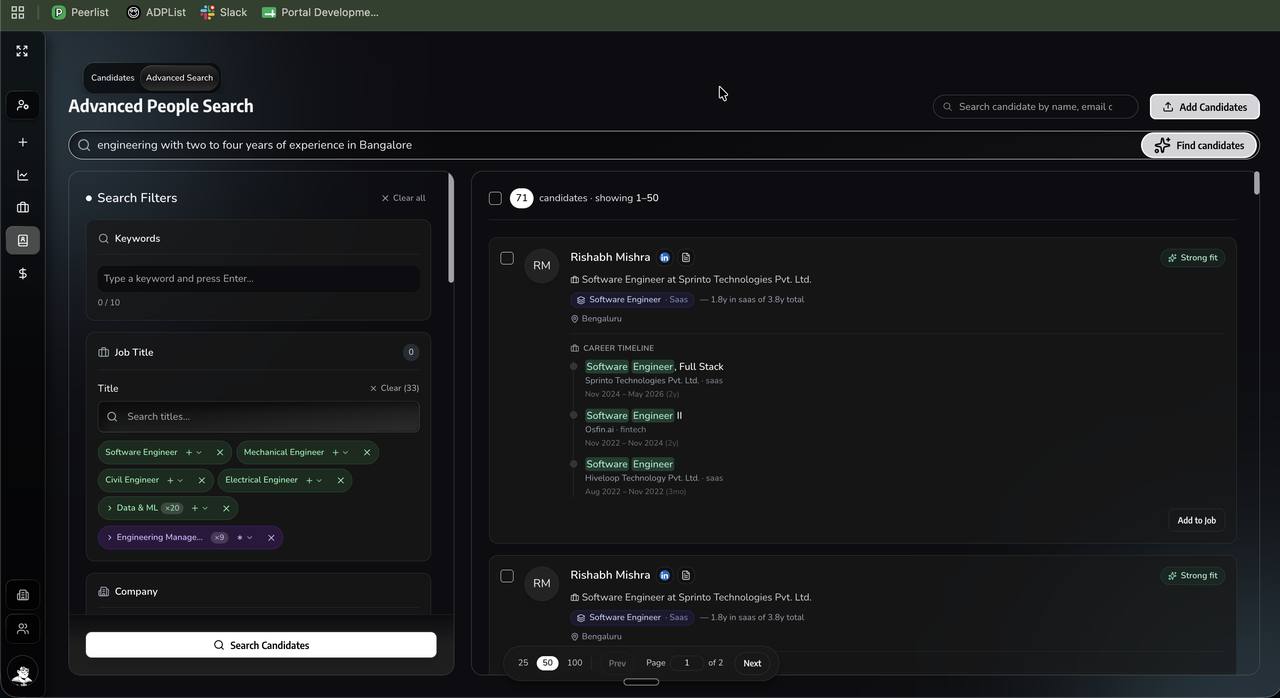
A usable segment has four constraints: capability, level, location, and an availability signal. "Java developers" is not a segment. "Java developers, 4 to 7 years, Pune, whose notice period we confirmed in the last six months" is one.
Narrow segments feel uncomfortable because the list is short. Short lists reply. The 40 percent call response rate above is measured on people who were a genuine fit for the role, and it would collapse on a broad pull.
This is also where searching your own database beats a fresh portal pull, because your own records carry the availability signal that an external list does not.
The four things a message has to do
Say why them, specifically
One clause that could not have been sent to anyone else. This single element separates outreach from spam, and candidates identify it in about two seconds.
Say what the role is
Company type, level, location and a compensation indication. Withholding the number costs you more replies than it protects, and our own response figures are measured on roles where the number was strong and stated.
Say why it is worth their time
Something specific about scope, team or trajectory. Not "exciting opportunity", which appears in roughly every message they received this week.
Ask one easy thing
A yes or no question, not a request for a 30-minute call. The commitment you ask for in message one should be proportionate to the relationship, which is none.
Four sequences that do not work
Patterns we see constantly, each of which wastes the channel advantage described above.
Calling first, on everyone
The phone has the best response rate and the worst economics. Spending it on an unfiltered list of 300 people burns a recruiter's entire day to reach the same people a WhatsApp message would have surfaced for free.
Email only, because it scales
It does scale, and it converts at a third the rate of a call. A firm running email-only outreach and complaining about response rates has chosen the cheapest channel and is measuring the consequence.
Same channel four times
Someone who ignored your first email will ignore the fourth. Changing channel is most of what a follow-up sequence is for, because non-response usually means the channel failed rather than the message did.
Nine touches in three days
This gets you blocked, reported and remembered. The candidate who would have replied on day four never gets the chance, because they muted you on day two.
Measuring, and knowing when to stop
Three numbers at day seven.
Delivery rate. If this is low, the problem is data quality rather than copy, and no rewrite will fix it.
Response rate by channel. Compare against your own baseline, not against the figures in this post. Ours are from our market and our roles.
Positive response rate. Replies that are actually interested, as a share of all replies. A high response rate with a low positive rate means the segment was wrong, and rewriting the copy will not help.
Kill the campaign at day seven if positive responses are below your threshold. Then rewrite the segment, not the message.
Why candidate response rates fall over time
A sequence that worked last year quietly stops working, and teams usually blame the copy. Three causes are more likely.
The segment has been contacted before
Response rate is partly a function of novelty. A pool contacted three times in eighteen months responds worse than a fresh one, regardless of what the message says. This is the strongest argument for logging contact history against the record rather than in a campaign tool.
The roles got weaker
Our figures are conditional on strong compensation. If the desk has drifted towards lower-paying roles, response falls for reasons no rewrite will address.
Contact data has decayed
A falling response rate and a falling delivery rate look identical in most reporting. Check delivery first. If numbers are dead and emails are bouncing, the problem is the database, not the outreach.
Frequently asked questions
What is a good candidate response rate?
In our own outreach on well-paid, credible roles, roughly 40 out of 100 people respond to a phone call, 25 respond on WhatsApp and 12 to 15 respond by email. Weaker roles perform materially worse on every channel, so treat these as a ceiling rather than an average.
Which channel gets the highest response from candidates?
The phone, by a clear margin, followed by WhatsApp and then email. This surprises teams who assume messaging has replaced calling. A call is harder to ignore and easier to answer in thirty seconds, and it carries an implicit signal that the role is worth a person's time.
How many times should you follow up with a candidate?
Four touches across roughly ten days, changing the channel each time. Beyond that, additional messages damage your brand more than they generate replies, and the person who was going to respond has already done so.
Is WhatsApp appropriate for recruitment outreach?
In India it is a normal and well-received channel when the message is relevant and clearly identifies you. In other markets it can read as intrusive. Match the channel to the market rather than to your own preference.
Should you include salary in the first message?
Including a band consistently improves reply quality, because it filters out mismatches before they cost anyone a call. Our channel response rates are measured on roles with strong compensation, and that is not a coincidence.
Why is my recruitment outreach getting no replies?
Usually the segment, not the copy. A precise segment with average wording outperforms brilliant wording sent to a broad list. If the positive reply rate is low while the raw reply rate is fine, the segment was wrong.
One channel most firms ignore
Referral from a candidate you have already placed sits outside these three numbers and outperforms all of them.
The mechanism is trust transfer. Someone contacted by a recruiter is evaluating a stranger. Someone contacted because a former colleague suggested them is evaluating that colleague's judgement, which is a much shorter conversation.
It does not scale, which is why it rarely appears in a channel comparison. But on niche senior roles where a 12 percent email response makes the desk unviable, it is often the only channel that works. Ask every placed candidate for two names at the point they accept, not six months later.
How to set your own baseline
Run one campaign to fifty people from your own database, not five hundred from a fresh pull. Fifty is enough to read a signal and small enough that you will actually personalise the segment.
Record responses by channel and by day. After three campaigns you have a baseline that is worth more than any published benchmark, including this one.
See channel response rates on your own pool
We will run one segmented campaign across call, WhatsApp and email against your own database and show you where the replies come from.
Book a demoFounder of Sortinghat, an AI-native ATS and CRM for staffing, search and RPO firms. Writes about recruiter capacity, sourcing economics and what actually changes when AI reaches a delivery desk. More about the author
Related reading
High Volume Recruiting: What One Screening Day Actually Produces
Talent PoolTalent Pool Software: How to Rank Your Own Database Before You Pay a Job Portal
WorkflowRecruiter Admin Time: Where the Hours Actually Go, and What Automatic Capture Removes
AI ImpactWhat AI Actually Changed About Outbound Recruiting