Hiring for Business Roles: Sales, Marketing and Finance
Half the market, a fraction of the content. Business hiring has its own signals and technical playbooks read them badly.
Technical recruitment has a testable output: somebody either built the thing or they did not. Business roles have no equivalent, which is why the same screening approach produces confident and wrong shortlists. A salesperson's number depends on the territory, the product and the year. A marketer's campaign depends on the budget. Reading those correctly is the entire skill, and it is different from reading a technical CV.
Last reviewed August 2026. Delivery observations from Sortinghat customer base, stated as directional.
Key takeaways
- Context decides whether a number means anything. Quota attainment without deal size, cycle length and territory is not information.
- Transferability is the real question. Someone selling small deals in a short cycle rarely transfers to enterprise, and the CV will not say so.
- The strongest signal is repeat performance. One good year is variance. Three is a pattern.
- Interviewing well is part of the job for these roles. Which makes interview performance a weaker signal than it is for technical hires.
Why a sales number on its own is meaningless
A candidate at 130 percent of quota tells you nothing until you know four things: the deal size band, the sales cycle length, whether the territory was established or new, and what the quota actually was.
Somebody hitting 130 percent on a modest quota in a mature territory with inbound leads is a different hire from somebody hitting 95 percent on an aggressive quota building a new market from scratch. The second is frequently the better candidate and the CV makes the first look stronger.
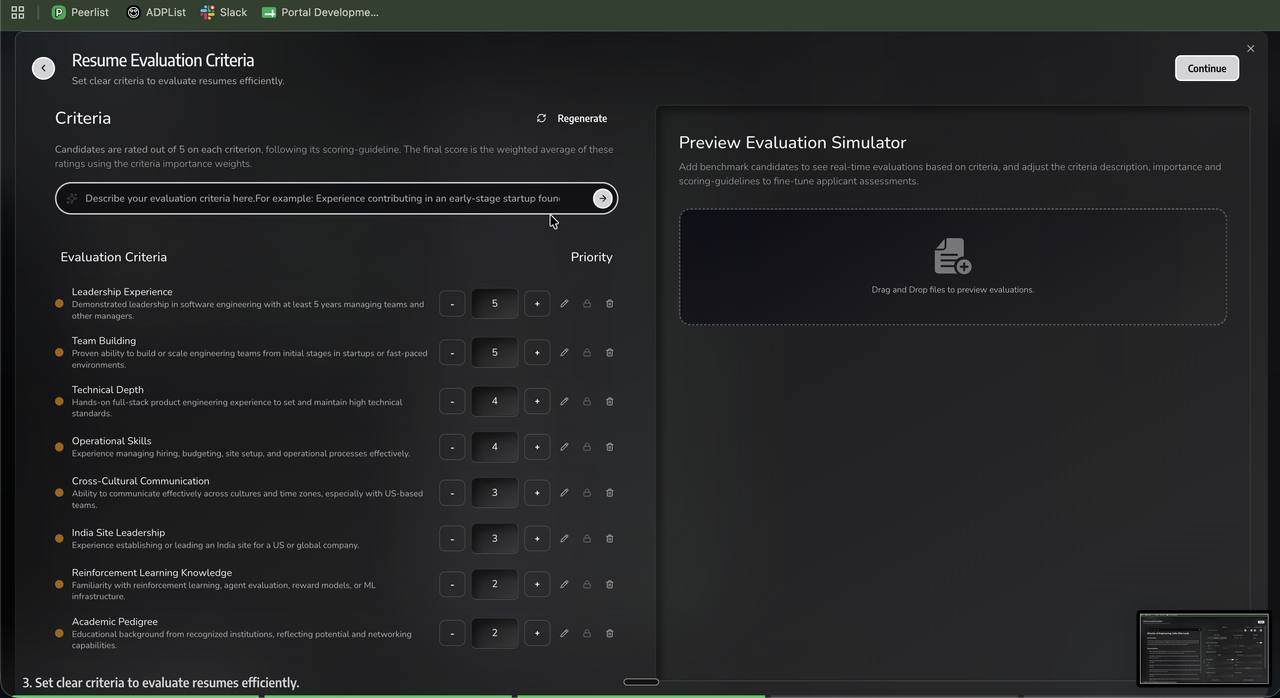
This is precisely what weighted evaluation criteria are for: making deal size and cycle length explicit criteria rather than context somebody remembers to ask about.
Transferability, and where it breaks
The most common expensive mistake in business hiring is assuming that sales is sales.
Deal size. Someone selling at five lakh does not reliably transfer to two crore. The buying committee, the timeline and the required patience are all different.
Cycle length. Short-cycle sellers frequently churn out of long-cycle roles inside a year, because the feedback loop they are used to disappears.
Motion. Inbound, outbound, channel and partnership sales are different jobs. A strong inbound closer given a cold outbound territory often fails, and neither party saw it coming.
Marketing has the same structure. Brand, performance, product and content marketing share a title and very little else.
What actually predicts success
Repeat performance across contexts. Three good years across two companies is a far stronger signal than one exceptional year, because it separates the person from the circumstances.
Specificity about failure. A candidate who can describe a deal they lost and why is describing something they actually experienced. Vagueness here is the clearest warning available.
Evidence of process. How they build a pipeline, qualify, forecast. Strong performers have a method they can articulate; lucky ones describe outcomes.
Reference quality at the right level. A manager reference matters more than a peer one for these roles, because the failure modes are visible from above.
Why interview performance misleads here
Business roles select for people who present well, which means the interview measures a skill the candidate has specifically trained.
A technical interview can ask somebody to solve a problem. A sales interview mostly asks somebody to talk about selling, which is a task at which good and mediocre salespeople both perform adequately.
The counterweight is structure. A screening conversation that probes specifics rather than inviting narrative catches more than an unstructured chat, which is the same principle described in structured screening. The claims that fail are the numbers, and they fail under a second question.
Finance and operations roles
Different again, and frequently lumped in with the rest.
These roles are qualification-gated in a way sales is not: the certification either exists or it does not, and it is checkable. What is harder to assess is judgement under ambiguity and the willingness to escalate, both of which decide whether somebody is useful in a small finance team.
The most common failure is hiring for technical accounting capability into a role that actually needs commercial partnering, or the reverse. That is a briefing failure and it is visible in the job description if anybody reads it critically.

Frequently asked questions
How do you assess a salesperson in recruitment?
By putting the number in context. Quota attainment means nothing without deal size band, sales cycle length, whether the territory was established or new, and what the quota actually was. The strongest signal is repeat performance across more than one company.
Do salespeople transfer between deal sizes?
Frequently not. Someone selling small deals in short cycles rarely transfers to enterprise sales, where the buying committee, the timeline and the required patience are all different. The CV will not flag this, so the criteria must.
Why is interview performance a weak signal for business roles?
Because these roles select for people who present well, so the interview measures a skill the candidate has trained specifically. A technical interview can pose a problem to solve; a sales interview mostly invites somebody to talk about selling.
What predicts success in a sales hire?
Repeat performance across different contexts, specificity when describing a deal they lost, an articulable process for building and qualifying pipeline, and a manager-level reference rather than a peer one.
Is marketing hiring similar to sales hiring?
Structurally yes. Brand, performance, product and content marketing share a title and very little else, so transferability is the same question. The context that makes a result meaningful is budget rather than territory.
What goes wrong in finance hiring?
Usually a briefing failure: hiring for technical accounting capability into a role that needs commercial partnering, or the reverse. The qualification is checkable; the judgement and escalation behaviour that decide usefulness are not.
The four questions to add to your intake
For any sales role, ask the client four things before you search: what deal size, what cycle length, established or new territory, and what the quota was for the person who last did this well.
Without those, every CV looks similar and every shortlist is a guess. With them, the criteria write themselves and the rejections stop being surprising.
Build criteria for a business role
Bring a sales or marketing brief and we will generate the criteria that make a number mean something.
Book a demoFounder of Sortinghat, an AI-native ATS and CRM for staffing, search and RPO firms. Writes about recruiter capacity, sourcing economics and what actually changes when AI reaches a delivery desk. More about the author
Related reading