Sortinghat vs JobDiva: The 2026 Comparison for Large US Staffing Operations
JobDiva was built for large US contract staffing before AI existed. The scale is real. So is the amount of manual work it still requires.
JobDiva handles volume, and it handles it the way software handled volume in 2005: more recruiters, more screens, more clicks. Every candidate is found by a person, called by a person and evaluated by a person. Sortinghat runs the same contract desks with the sourcing, screening and evaluation automated, which is why the same headcount carries more roles.
Last reviewed June 2026. JobDiva information taken from its published pricing and product documentation.
Key takeaways
- Both run at large contract volume. Sortinghat carries full front and back office including pay-and-bill, timesheets and invoicing, with 400+ pre-built integrations.
- Only one screens candidates without a recruiter dialling. Native AI voice and video calls, 70% completion, 3 to 7 minutes, against criteria generated from the job description.
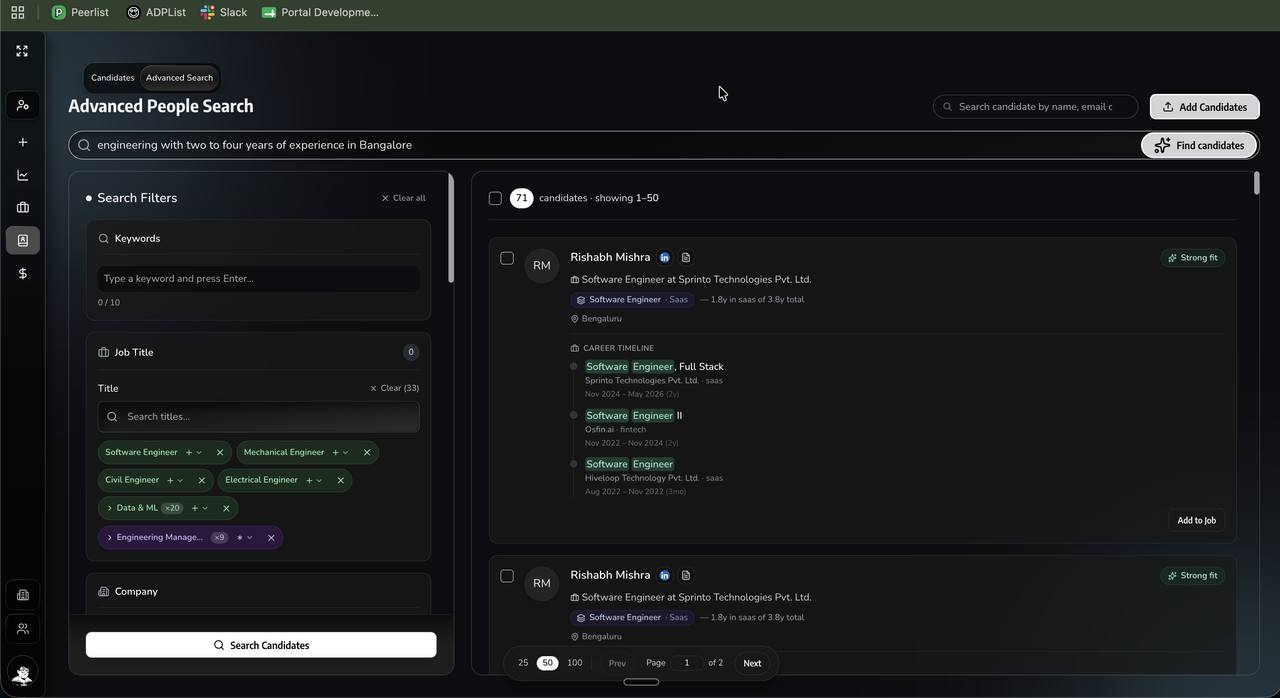
- Search is a sentence rather than a filter stack. Compound conditions that never appear as keywords resolve without anyone building a query.
- Migration takes two weeks and nothing is left behind. Notes, call history, attachments and submission history all carry across, and anything your desk needs that is missing gets built during the migration rather than added to a roadmap.
Scale through headcount versus scale through automation
JobDiva's approach. A platform built for large US contract staffing, with harvesting, VMS connectivity and back office. It scales by giving more recruiters more screens. The work itself has not changed since the platform was designed.
Sortinghat's approach. The same contract coverage, with the sourcing and qualification automated. Plain-language search across your own database. AI voice and video screening against the role's weighted criteria. Evaluation generated from the job description. Notes written automatically from calls, WhatsApp and email.
Both platforms handle a thousand-seat desk. Only one of them changes how many people it takes to run.
Sortinghat vs JobDiva at a glance
| Category | JobDiva | Sortinghat |
|---|---|---|
| Built for | Large US contract staffing volume | Enterprise staffing, search, RPO and GCC |
| Scaling model | More recruiters on more screens | More roles per recruiter |
| AI voice screening | Not native | Native, 70% completion, 3 to 7 minutes |
| AI video interviews | Not native | Native |
| Search | Harvesting plus filters and keywords | Plain language, ranked, explainable |
| Evaluation | Manual review | Weighted criteria generated from the job description |
| Back office | Contract, timesheets, billing | Full front and back office, pay-and-bill, timesheets, invoicing |
| Integrations | Established set | 400+ pre-built, plus open read-write API |
| India channels | Limited | Native Naukri and WhatsApp threading |
| Implementation | Project, typically billed | Two weeks, included, gaps built during migration |
Row two is the whole comparison. Adding volume on JobDiva means adding recruiters. That is a cost line, not a strategy.
Where the two platforms actually differ
Finding people in your own database
JobDiva. Search is filter and keyword driven, so results depend on how precisely the query was built. An imprecise query quietly misses qualified people and nobody finds out.
Sortinghat. Describe the person in a sentence, including conditions that are judgements rather than keywords. Our audit of one firm's 3 million records found 80% were real, current people behind stale records, and making them findable took job portal spend from roughly $100 a role to $60.
Bottom line: A database nobody can search is storage you are paying to keep.
Qualifying the people you find
JobDiva. Screening is a recruiter activity. A full manual calling day is around 40 calls and produces three or four people worth submitting.
Sortinghat. AI voice and video screening runs against the role's weighted criteria, confirming interest, availability, compensation and the CV claims that decide the submission. Around 300 contacted in parallel produces roughly 10 submission-ready profiles in hours, and on a high-volume QA requirement we submitted 120 in a single day.
Bottom line: This is the difference that shows up in placements rather than in a feature list.
Reporting and desk economics
JobDiva. Reporting covers pipeline and activity. Connecting recruiter activity to desk margin generally means exporting and rebuilding it outside the platform.
Sortinghat. Desk margin, recruiter capacity and pipeline forecasting sit in the same workspace as the data they measure, so a founder sees which desks are profitable without a spreadsheet in between.
Bottom line: Reporting activity is not the same as knowing what it earned.
Adoption, which is where most rollouts fail
JobDiva. Implementation is a project, and whether the team adopts it afterwards is left to the team.
Sortinghat. Implementation, migration, training and any gap-filling customisation are included in the licence. If your desk depends on something the platform does not have, we build it inside the migration window rather than logging it on a roadmap.
Bottom line: The most common failure in this category is not a bad platform. It is a good one nobody switched to.
What each platform actually costs to run
JobDiva does not publish transparent pricing and quotes vary by module and seat count. Ask for a three-year total covering implementation, every module you would license and the renewal escalation.
The licence is rarely the largest line. Six costs decide what a platform actually costs over three years:
| Cost line | On the quote? | How it behaves |
|---|---|---|
| Licence | Yes | Seats times tier price, plus renewal escalation |
| Implementation | Sometimes | One-off, often via a partner. Included with Sortinghat. |
| Migration | Rarely | Vendor fee plus your team's hours. Included with Sortinghat. |
| Modules to reach a working setup | No | Where quotes diverge most between vendors |
| Recruiter hours | No | The largest line by far, and the one nobody models |
| Job portal spend | No | Does it reduce it? One firm went from $100 a role to $60 |
The last two lines are usually larger than the first four combined. A platform that removes an hour a day from every recruiter is not comparable to one that costs slightly less per seat.
What Sortinghat does that JobDiva does not
AI is in the platform, not on the invoice
Voice screening, video interviews, the AI interview assistant, evaluation against weighted criteria, natural language search and the notetaker are all part of the platform. There is no AI tier, no separate contract and no account manager conversation before you can use them.
Search is a sentence, not a Boolean string
Describe the person you want and get a ranked result. Compound conditions that never appear as keywords, institution tier, company stage, domain depth, resolve without anyone building a query. Sourcers are productive in a session rather than a quarter.
Screening runs at enterprise volume
A pool search on a volume role surfaces around 1,200 relevant profiles, narrows to a ranked 300, and contacts them by call, WhatsApp and email in parallel. That produces roughly 10 submission-ready profiles in hours. On a high-volume QA requirement we submitted 120 profiles in a single day.
Full front and back office
Timesheets, invoicing and pay-and-bill alongside the ATS and CRM, with client-specific formats built to your requirement rather than configured around.
400+ pre-built integrations
Job portals, messaging, calendar, assessment, interview and finance systems, plus an open read-write API for everything else.
Migration in two weeks, and gaps get built
Notes, call history, attachments and submission history carry across. If your desk depends on something the platform does not have yet, we build it inside the migration window rather than logging it on a roadmap. Implementation, migration, training and that customisation are included.
Built for firms running at scale
Our customers include firms of 400+ employees. The platform is designed for enterprise staffing volume rather than scaled down from it.
Switching from JobDiva: what it takes
Large JobDiva instances carry years of contract history, which is exactly why the migration should be handled rather than exported.
- Contract and assignment history. Commercially your most important records. We validate these first rather than assuming the export was complete.
- Timesheet and billing history. Because we carry back office, this moves with the front office instead of splitting across two vendors.
- Custom fields. Long-tenured instances accumulate fields specific to individual clients. We audit which are still live.
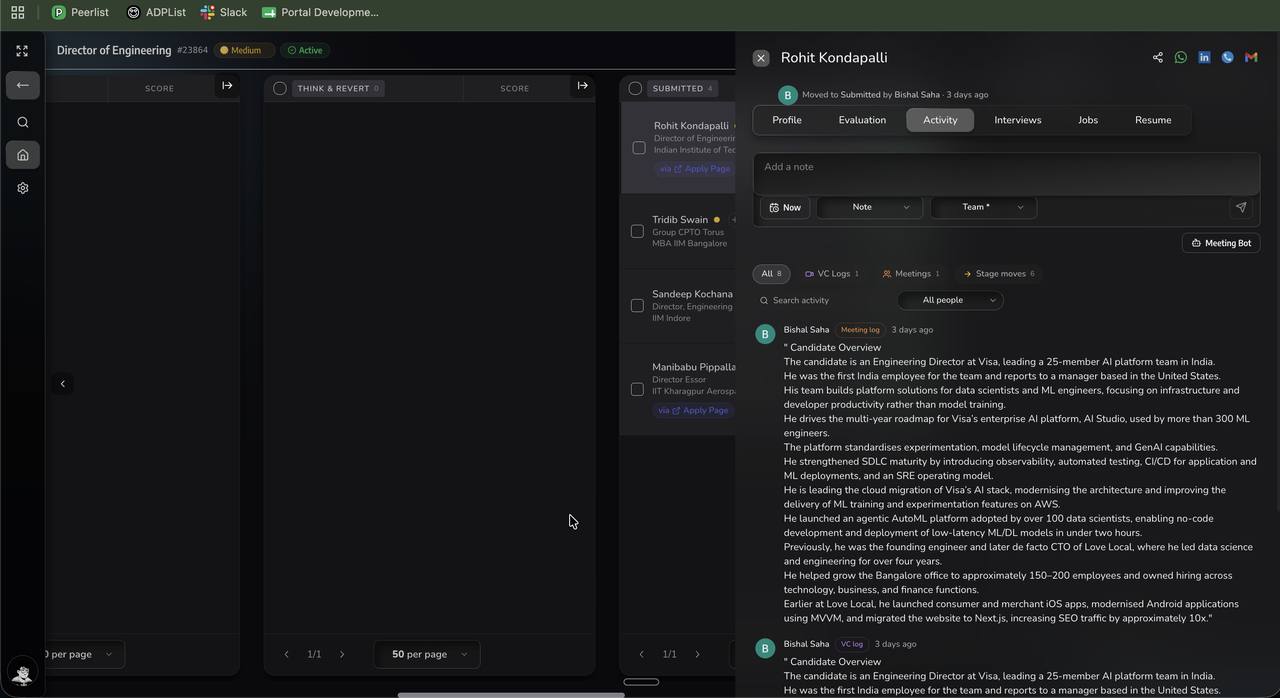
- Notes, calls, attachments and submission history all carry across, validated with your team before sign-off.
Our migrations run in two weeks. Week one is export, field mapping and validation while your team keeps billing. Week two is your own environment, your team's specifics and full validation before anyone signs off. Go-live is a final export and cutover with no downtime. Implementation, migration, training and any customisation your desk needs are included rather than quoted as professional services.
Where JobDiva is still a good choice
Not every firm should switch, and these are the cases where JobDiva remains the better answer.
- You renewed a multi-year agreement last quarter. Switching economics work better at renewal. Note the date and revisit then.
- You went live in the last twelve months. If the team has just absorbed one implementation, another this year is a hard internal sell.
Frequently asked questions
What is the best JobDiva alternative for large staffing firms?
For firms who want the same contract volume without adding headcount, Sortinghat adds AI voice and video screening, plain-language search and generated evaluation criteria on top of full front and back office, with 400+ pre-built integrations.
How much does JobDiva cost?
JobDiva does not publish transparent pricing and quotes vary by module and seat count. Ask for a three-year total covering implementation, every module you would license and the renewal escalation.
Does Sortinghat handle large contract staffing?
Yes. Our customers include firms of 400+ employees, with full front and back office including pay-and-bill, timesheets and invoicing, plus 400+ pre-built integrations and an open read-write API.
How long does a JobDiva migration take?
Two weeks. Export, mapping and validation in week one while your team keeps billing, then your own environment and full validation in week two, followed by cutover with no downtime.
Will contract and timesheet history transfer?
Yes. Because Sortinghat carries back office, contract, assignment and timesheet history moves alongside the front office rather than being split across two vendors.
Is Sortinghat suitable for US contract desks?
Yes, including compliance documentation and client-specific invoicing formats, which we build during the migration window if your clients require them.
Bottom line
JobDiva scales by adding people. That worked when there was no alternative. Sortinghat runs the same contract volume with sourcing, screening and evaluation automated, full front and back office underneath and 400+ pre-built integrations, live in two weeks with implementation and training included. If your plan for growth is hiring more recruiters, the platform is the reason.
See it running on your own data
Bring a live role and a sample of your database. We will run the search, build the scorecard and show you the shortlist against your own criteria.
Book a demoFounder of Sortinghat, an AI-native ATS and CRM for staffing, search and RPO firms. Writes about recruiter capacity, sourcing economics and what actually changes when AI reaches a delivery desk. More about the author
Related reading
Sortinghat vs PCRecruiter: The 2026 Comparison for Established Recruiting Firms
Product Comparison 101Sortinghat vs Loxo: The 2026 Comparison for Search and Staffing Firms
Product Comparison 101Sortinghat vs JobAdder: The 2026 Comparison for ANZ, UK and Global Agencies
Product Comparison 101Sortinghat vs Vincere: The 2026 Comparison for International Staffing Firms