Volume Hiring: What It Takes to Staff 1,000 Seats in 30 Days
Large ramps fail on arithmetic that nobody did at the start, not on effort at the end.
A thousand seats in thirty days is a funnel problem before it is a recruiting problem. Work backwards from the offer acceptance rate through interview conversion, screening throughput and contact rate, and the required top of funnel is usually an order of magnitude larger than anyone assumed. Firms that do that arithmetic in week one deliver. Firms that start sourcing immediately discover the gap in week three, when it is too late.
Last reviewed August 2026. Delivery observations from Sortinghat customer base, stated as directional.
Key takeaways
- The arithmetic decides it before anyone sources. Work backwards from acceptance rate to top of funnel and the required volume is usually far larger than assumed.
- Screening throughput is the binding constraint. A manual recruiter manages around 40 calls a day, which caps the whole project at headcount.
- Client-side capacity fails more often than supply. If the client can interview 30 a day, sourcing 300 a day helps nobody.
- Attrition during the ramp is the hidden cost. People accept and do not join, and the plan has to carry that from the start.
The arithmetic nobody does first
Work backwards, not forwards.
A thousand joiners requires more than a thousand offers, because some accept and do not turn up. Those offers require several times as many final interviews. Those interviews require several times as many submissions. Those submissions require several times as many screened candidates. And those screens require a contacted pool several times larger again.
Multiply the conversion rates from your own history and the top-of-funnel requirement emerges. It is almost always larger than the client expects and larger than the agency assumed when it accepted the mandate.
Doing this in week one changes what you agree to. Doing it in week three changes nothing.
Why screening is the binding constraint
Sourcing at volume is comparatively easy. Qualifying at volume is what caps the project.
A recruiter running manual screening manages around 40 calls a day and finds three or four people worth submitting. At that rate, a thousand-seat ramp in thirty days requires a floor of recruiters that most firms do not have and cannot hire in time.
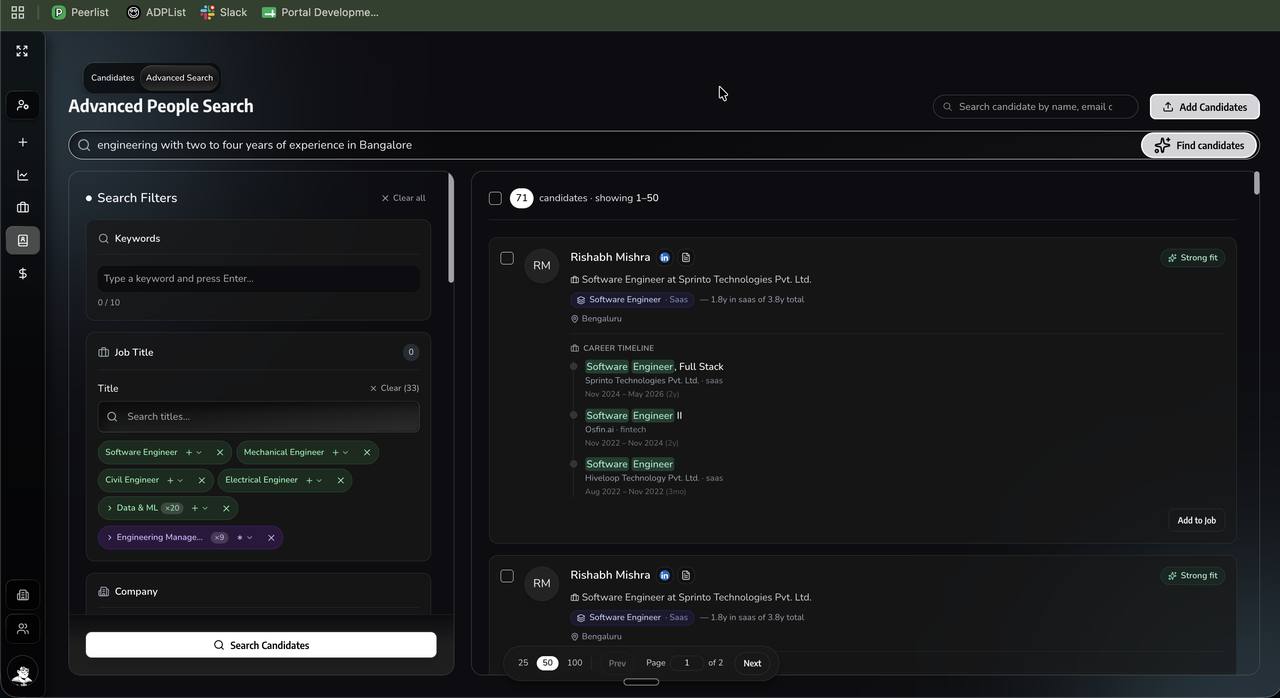
Filtering before contacting changes the arithmetic rather than the effort: a pool search surfaces around 1,200 relevant profiles, narrows to a ranked 300 contacted in parallel across call, WhatsApp and email, and produces roughly 10 submission-ready profiles in hours. The full mechanics are in what one screening day produces.
Client-side capacity, the constraint people forget
The most common cause of a stalled ramp is not supply. It is that the client cannot process what you send.
If the client can conduct thirty interviews a day, submitting three hundred candidates a day creates a backlog, a poor candidate experience and a queue of people who take other jobs while waiting.
Agree interview capacity per day before the project starts and build the sourcing plan to match it. A ramp that delivers evenly against client capacity beats one that front-loads and then stalls, every time.
Where these projects actually fail
Offer-to-join leakage. Candidates accept and do not appear. On volume ramps this rate is higher than on individual placements and it has to be in the plan from day one, not discovered in week four.
Quality drift. As the deadline approaches, the bar quietly drops. Three months later the client's attrition tells the story and the account does not renew.
Coordination collapse. Interviews double-booked, candidates contacted twice, offers delayed. At volume, coordination failures compound faster than sourcing failures.
Recruiter burnout. A thirty-day sprint run on manual effort costs people afterwards, and the cost lands in the following quarter.
What to agree before you accept the mandate
Five things, in writing.
Interview capacity per day, and who is accountable for it on the client side.
Decision turnaround, in hours rather than days. At volume, a two-day decision lag loses candidates continuously.
The quality bar, defined as criteria, so that drift is visible rather than gradual. This is what weighted criteria are for.
What happens if the client stalls. Your cost continues whether or not they interview.
Replacement terms for the ramp cohort, which will differ from your standard terms because the risk profile is different.
Frequently asked questions
How do you plan a 1,000-seat hiring ramp?
Work backwards from the required joiners through acceptance rate, interview conversion, submission rate and contact rate to establish the top-of-funnel requirement. That arithmetic in week one determines whether the mandate is deliverable at all.
What is the main constraint in volume hiring?
Screening throughput. Sourcing at volume is comparatively easy; qualifying at volume caps the project. A recruiter running manual screening manages around 40 calls a day and finds three or four people worth submitting.
Why do large hiring ramps stall?
Frequently because the client cannot process the volume. If they can interview thirty a day, submitting three hundred creates a backlog, a poor candidate experience and a queue of people who take other jobs while waiting.
What is offer-to-join leakage on volume hiring?
The share of candidates who accept an offer and do not turn up. It runs higher on volume ramps than on individual placements and it needs to be built into the plan from day one rather than discovered in week four.
How do you prevent quality drift on a ramp?
By defining the bar as explicit weighted criteria rather than as a general standard, so that any relaxation is visible rather than gradual. Drift is usually invisible until client attrition surfaces it months later.
What should you agree with the client before a volume mandate?
Interview capacity per day with a named owner, decision turnaround in hours, the quality bar defined as criteria, what happens if the client stalls, and replacement terms specific to the ramp cohort.
The calculation to do before you say yes
Take your own historical conversion rates and work backwards from the joiner number the client wants. If the top-of-funnel requirement exceeds what your database and channels can realistically produce in the window, say so before signing rather than after week three.
Declining a ramp you cannot deliver costs one mandate. Accepting one you cannot deliver costs the client.
Run the funnel arithmetic on a live ramp
Bring the seat count and the deadline and we will show you what your own pool can actually produce.
Book a demoFounder of Sortinghat, an AI-native ATS and CRM for staffing, search and RPO firms. Writes about recruiter capacity, sourcing economics and what actually changes when AI reaches a delivery desk. More about the author
Related reading
High Volume Recruiting: What One Screening Day Actually Produces
WorkflowHiring Scorecards: How to Turn a Job Description Into Weighted Evaluation Criteria
AI ImpactAI in Temp and Light Industrial Staffing: What Actually Helps
SegmentsDiversity Hiring: What Works, What Is Theatre, and What Agencies Can Change