AI and Client Retention: What Actually Keeps a Staffing Account
Everyone writes about AI in delivery. Almost nobody writes about AI in keeping the client, which is where the money actually sits.
Staffing firms rarely lose accounts because the candidates were bad. They lose them because the client stopped hearing from them, because a competitor was faster on three consecutive roles, or because the person who held the relationship left and took the context with them. Two of those three are automation problems, and the third is a data problem.
Last reviewed July 2026. Retention patterns from Sortinghat customer delivery, stated as directional.
Key takeaways
- Delivery quality is rarely the stated reason for churn. Silence, speed and a departed relationship holder account for most of it.
- Client updates are the task recruiters skip most reliably. And the omission is one of the most common reasons a client quietly moves on.
- Speed compounds across roles. Losing three consecutive roles to a faster supplier ends an account more surely than one bad submission.
- Relationship history has to belong to the firm. If it lives in one recruiter's memory and phone, it leaves when they do.
Why clients actually leave
Ask a departing client and you get a polite answer about fit. Ask the recruiter and you get a different one. Four causes cover most of it.
They stopped hearing from you. Progress was happening and nobody reported it, so the client concluded nothing was.
Somebody else was faster. Not better, faster. In contingency work the firm that submits first usually gets paid, and losing three in a row reads as incapability.
The relationship holder left. Their replacement started from nothing, asked questions the client had already answered, and the client noticed.
One bad experience was never repaired. Usually recoverable, and usually nobody knew it happened.
The update problem, and why it is structural
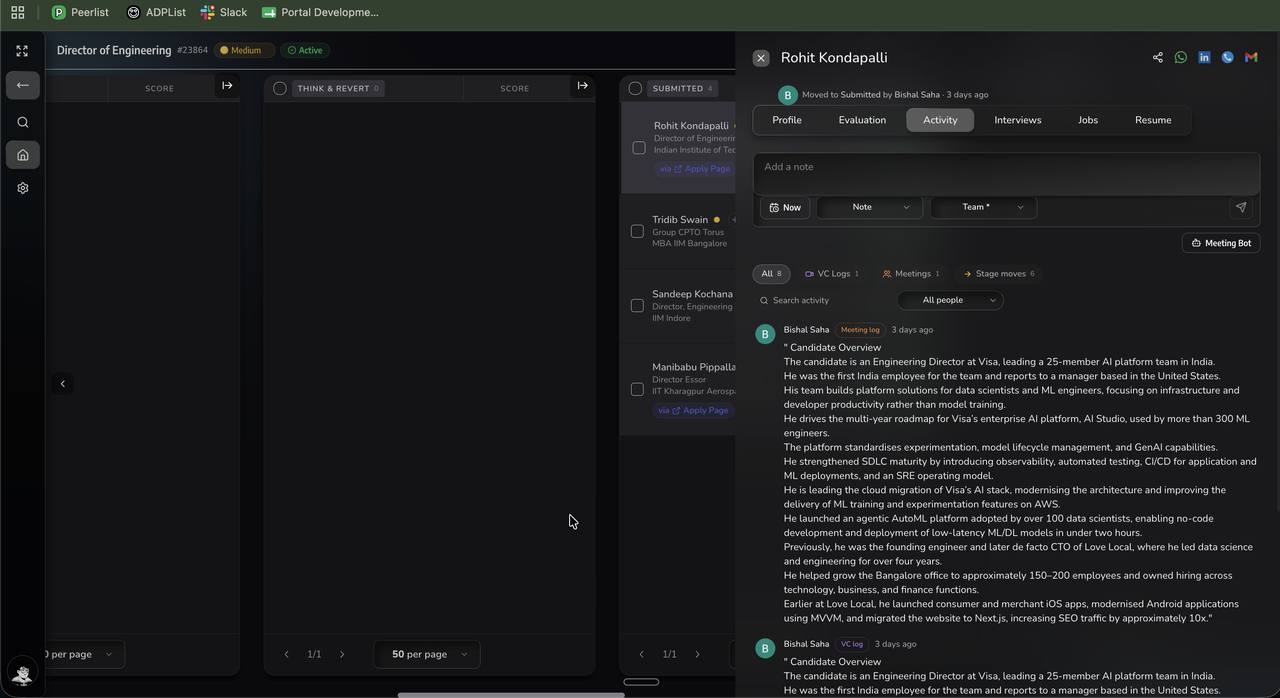
Client updates are the work recruiters skip most reliably. It is rarely neglect. Assembling one means pulling information from four places, and by Friday afternoon it can wait until Monday. Repeat that for six weeks and the client concludes nothing is happening.
The fix is that the update should not require writing. Progress on a role already exists in the system: candidates sourced, contacted, screened, submitted, scheduled. A report that assembles itself and goes out on a schedule removes both the task and the excuse.
The second-order effect matters more. A client receiving a weekly update stops asking for one, which removes an interruption from the recruiter's week and changes the relationship from chasing to reporting.
Speed as a retention mechanism
Speed is usually discussed as a win-rate issue. It is more consequential as a retention issue.
A client briefing three agencies notices which one comes back first, every time. That impression accumulates across roles independently of who eventually gets the placement. A firm that is consistently third is being evaluated as slow before anyone reads a CV.
The lever is not effort. A recruiter running manual screening manages around 40 calls a day and finds three or four worth submitting. Filtering first changes that to roughly 10 submission-ready profiles in hours, which is the difference between arriving first and arriving third.
Making the relationship belong to the firm
The most expensive retention failure is a resignation.
When a recruiter leaves a firm that logs manually, the client history leaves too. Some was in their head and most was on their phone. The replacement starts cold, asks questions the client has already answered, and the client draws a reasonable conclusion about how the firm operates.
The fix is capture rather than discipline. Calls, meetings, emails and WhatsApp threading onto the client record automatically means the firm retains the relationship history even when it loses the relationship holder. That is the retention argument for automatic note-taking, and it never appears in a demo because it is invisible until the day it matters.
What automation will not fix
A client you should not have taken. A misaligned account churns regardless of service quality, and qualifying the brief properly at the start is the only real defence.
A relationship nobody is investing in. Automated reporting is not a substitute for a conversation, and a client who only ever receives a generated update will notice that too.
Genuine delivery failure. If the shortlists are wrong, faster wrong shortlists do not help. That is a briefing and screening problem upstream of anything discussed here.
Frequently asked questions
Why do staffing clients leave?
Rarely over candidate quality. The common causes are silence when progress was not reported, being consistently slower than a competitor across several roles, the departure of the person who held the relationship, and one unrepaired bad experience nobody escalated.
How often should you update a staffing client?
Weekly, on a schedule, without being asked. The practical requirement is that the update assembles itself from pipeline data rather than being written manually, because manually written updates are the task recruiters most reliably skip.
Does speed affect client retention or just win rate?
Both, and retention more than most firms realise. A client briefing several agencies notices which comes back first every time, and that impression accumulates across roles independently of who wins any single one.
What happens to a client relationship when a recruiter leaves?
In a firm that logs manually, the history leaves with them. The replacement starts cold and asks questions the client has already answered. Automatic capture of calls, meetings and messages onto the client record keeps that history with the firm.
Can automation fix client churn?
It fixes the reporting gap and the speed gap, which together account for a large share of churn. It cannot fix a client you should not have taken, a relationship nobody invests in, or genuine delivery failure upstream in briefing and screening.
What is the most expensive retention failure?
A resignation at a firm where relationship history was never captured. The client is effectively starting over with a supplier they have already paid, and most clients will not do that twice.
The audit worth doing on your top five accounts
For each of your five largest clients, ask two questions. When did they last receive a progress update they did not request? And if the person who owns that account resigned tomorrow, could somebody else read the record and know where every conversation stood?
Those two answers predict which accounts you will still have in eighteen months more reliably than any satisfaction survey.
See a client record that survives a resignation
Bring one account and we will show you what automatic capture puts on the record without anyone typing.
Book a demoFounder of Sortinghat, an AI-native ATS and CRM for staffing, search and RPO firms. Writes about recruiter capacity, sourcing economics and what actually changes when AI reaches a delivery desk. More about the author
Related reading