India's AI Talent Market: Sharp Demand Growth Against a Large Skills Deficit
Demand for AI roles in India has grown faster than the supply of people who can do them, and the gap is widest exactly where the budgets are.
Demand for AI and machine learning roles in India has grown several times over in a short period, while the pool of people who can genuinely do the work has not. A large share of technology roles at global capability centres report a skills gap. For staffing firms this is the most profitable desk in the country and also the one where conventional screening fails most expensively.
Last reviewed July 2026. Skills gap and demand figures from NASSCOM sector reporting.
Key takeaways
- Demand growth has substantially outpaced supply. This is a shortage market, which means the fee supports real search work rather than volume delivery.
- A large share of GCC technology roles report a skills gap. The clients with the biggest budgets are the ones struggling hardest to fill.
- CV claims fail verification more here than anywhere else. Quantified impact on AI projects is the single most inflated claim we see on screening calls.
- Titles are unreliable in this market. Two people with identical job titles can be doing entirely unrelated work, which breaks title-based sourcing.
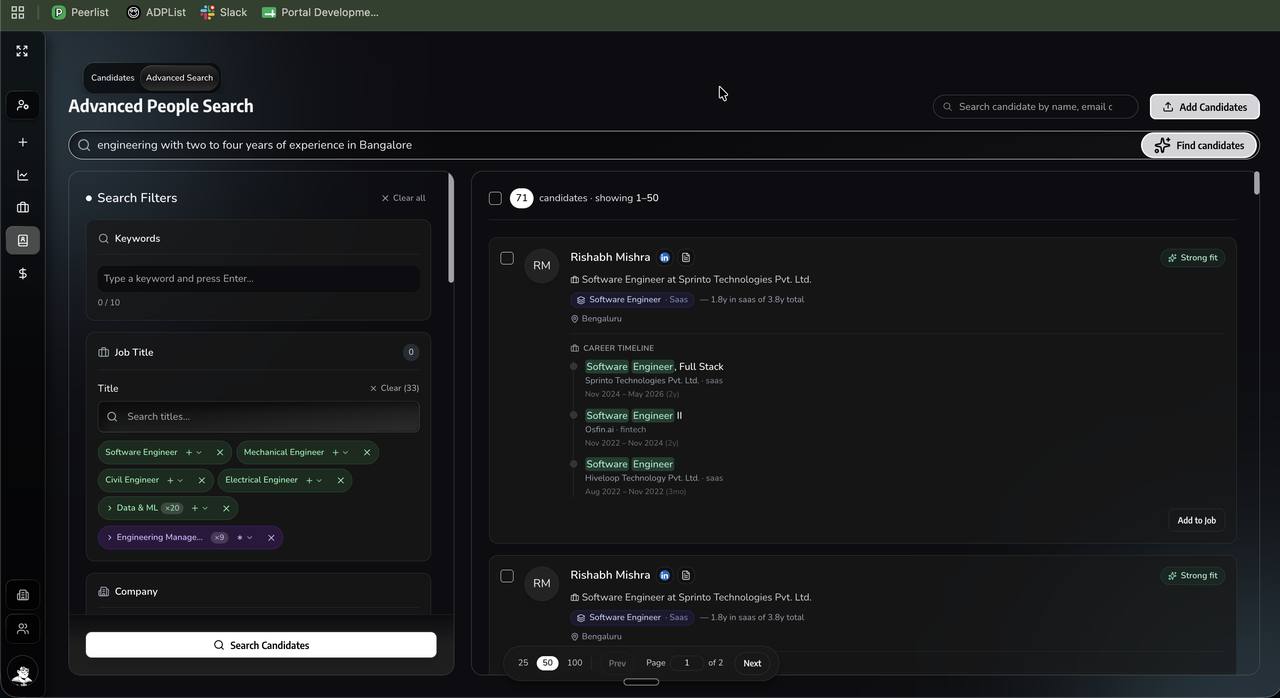
Why title-based sourcing fails in AI hiring
An ML engineer at one company builds models. At another, they maintain a pipeline that calls somebody else's model. At a third, they write prompts. All three have the same title and two of them cannot do the first job.
That breaks the standard sourcing motion, which starts from a title and filters on years. Searching for "machine learning engineer, five years" in this market returns a set where a large share are unqualified for the specific requirement, and no amount of Boolean refinement fixes it, because the distinguishing information is not in the title.
What works is describing the work rather than the role: what the person built, what they owned, which part of the stack, at what scale.
The claims that fail verification most often
Across screening calls, the claims that collapse under a second question are almost never about tools. They are about numbers, and AI roles produce more of them than any other segment.
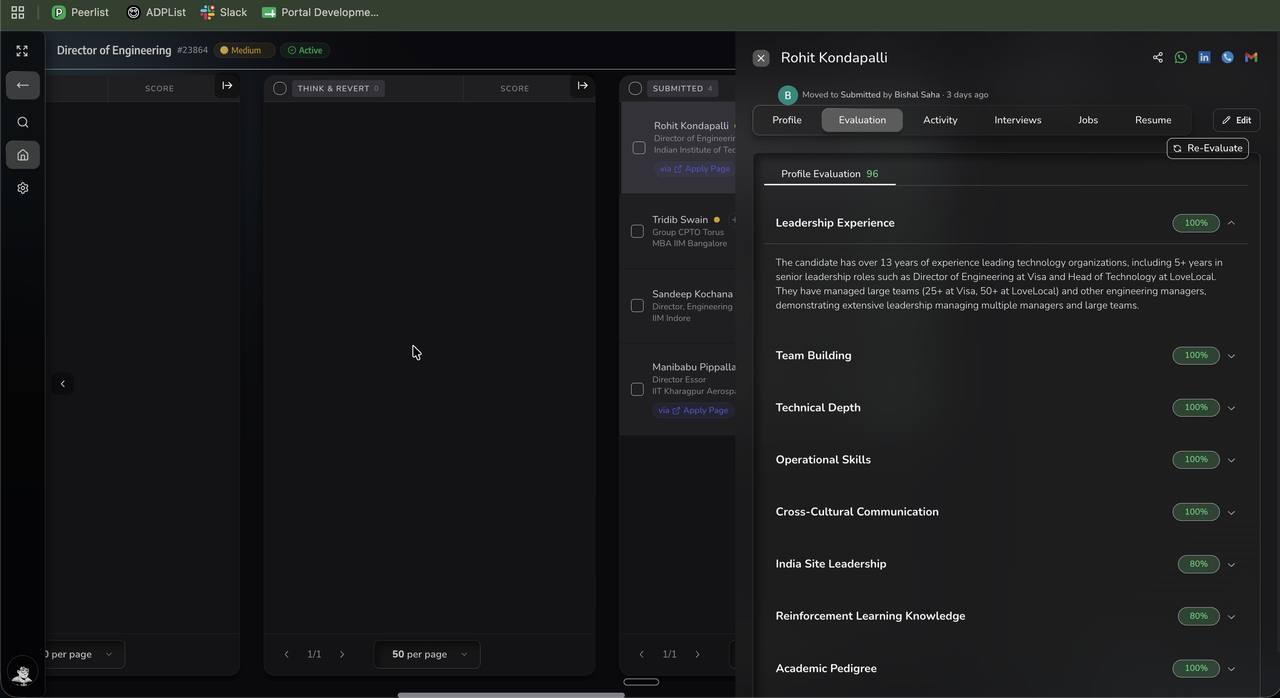
A CV says a model improved something by a specific percentage, or that a system handled a stated volume. The number is precise and reads well. Then the call asks what the baseline was, over what period, what the candidate personally owned as distinct from the team, and how it was measured.
Someone who did the work answers immediately and usually with more detail than was asked for. Someone who inherited the number, estimated it, or absorbed a team result becomes vague in a way that is unmistakable. Finding that out at screening costs four minutes. Finding it out at the client's technical interview costs the slot.
What a shortage market does to fees and timelines
Two effects, and both favour firms that can actually deliver.
Fees hold. A role that few agencies can fill supports a fee that a role anybody can fill does not. This is one of the few segments where discounting actively signals that you cannot deliver.
Timelines stretch, then compress violently. Clients search for months, then need somebody in three weeks because a project slipped. The firm that already has a warm, verified pool wins those, and the firm starting a fresh search does not.
That second dynamic is the argument for pipelining a domain before you have the requirement, which is expensive on any desk except one where the fee justifies it.
Where the supply actually is
Three pools, in descending order of how contested they are.
People currently in AI roles at recognisable companies. Heavily contested, expensive and frequently counter-offered. Everyone is looking here.
Strong engineers who have moved adjacent. Data engineers, backend engineers working on inference infrastructure, researchers in adjacent fields. Less contested and often a better hire, because the engineering fundamentals are harder to teach than the domain.
Your own database from two years ago. People who were doing adjacent work when you last spoke and have since moved into AI roles. Your records say the old title, which is exactly why nobody searches for them.
What a client is actually buying
In a shortage market, clients are not paying for access to a database. They are paying for verification.
Anybody can find fifty profiles with the right keywords. What a client cannot do cheaply is establish which of the fifty can actually do the work, and that is where the fee is defensible. A submission with evidence behind each claim is worth several times one without.
Which means the screening standard, not the sourcing reach, is what wins repeat business on an AI desk. Firms that submit fast and unverified get one mandate.
Frequently asked questions
Why is there an AI skills gap in India?
Demand for AI and machine learning roles has grown several times over in a short period while the pool of people who have genuinely built and shipped these systems has grown far more slowly. NASSCOM reporting shows a majority of technology roles at global capability centres report a skills gap.
How do you screen AI engineers effectively?
By testing the claims rather than the keywords. The claims that fail most often are quantified impact figures. Asking what the baseline was, over what period, and what the candidate personally owned separates people who did the work from people who were nearby when it happened.
Why does title-based sourcing fail for AI roles?
Because the same title covers entirely different work. One machine learning engineer builds models, another maintains a pipeline calling someone else's model. The distinguishing information is not in the title, so filtering on title and years returns a largely unqualified set.
Where can you find AI talent that is less contested?
Strong engineers who have moved adjacent, such as data engineers or backend engineers working on inference infrastructure. Also your own database from two years ago, where records show an old title for people who have since moved into AI roles.
Do AI recruitment fees hold up?
In a shortage market, yes. A role few agencies can fill supports a fee that a commodity role does not, and discounting in this segment tends to signal that a firm cannot actually deliver.
What do clients want from an AI staffing partner?
Verification rather than reach. Finding profiles with the right keywords is cheap. Establishing which of them can actually do the work is what a client cannot do easily, and that is where the fee is defensible.
The search worth running today
Search your own database for people who were doing data engineering or backend infrastructure work two to three years ago. Your records show the old title. A meaningful share of them are now in AI roles, and none of your competitors are looking for them because their records say the same thing.
That is a warm, uncontested pool that costs nothing to reach, and it only exists if your search can describe work rather than match a title.
Find the people your records mislabel
Bring one AI requirement. We will search your own database by what people built rather than what their record says they were called.
Book a demoFounder of Sortinghat, an AI-native ATS and CRM for staffing, search and RPO firms. Writes about recruiter capacity, sourcing economics and what actually changes when AI reaches a delivery desk. More about the author
Related reading