Best Recruitment Software for GCC Hiring Partners in 2026
India now hosts 2,117 global capability centres employing 2.36 million people, and almost no recruitment platform is built for the firms staffing them.
GCC hiring is not IT staffing with a different client name. The volumes are higher, the skill requirements are more specific, the stakeholder count is larger and the reporting expectations come from a multinational parent rather than a local hiring manager. India now hosts 2,117 GCCs across 3,728 units, employing roughly 2.36 million people. This guide compares seven platforms on what a GCC hiring partner actually needs.
Last reviewed June 2026. Platform information taken from published pricing pages and product documentation.
Key takeaways
- GCC hiring runs at volume with niche requirements. Both at once, which is the combination most platforms handle badly.
- Reporting goes to a multinational parent. Stakeholder count is higher and the reporting bar is set outside India.
- Tier-2 expansion changes the sourcing problem. Bengaluru holds a large share of units, and capacity is moving outward.
- Compare the tier you would actually buy. Entry pricing rarely includes the AI, automation or analytics most firms are evaluating on, and that is where quotes diverge.
Why GCC hiring breaks a standard ATS
Volume and specificity together. A GCC mandate can be 200 seats where each one has a genuinely narrow skill requirement. Platforms optimised for volume treat candidates as interchangeable; platforms optimised for search treat volume as an edge case.
Multi-stakeholder reporting. A local HR lead, a regional talent head and a parent-company function all want visibility, usually in different formats.
Skill definitions move quickly. A large share of GCC technology roles now carry a skills gap, and requirements shift faster than a static scorecard survives.
Data residency is asked early. A multinational parent asks where candidate data is hosted before it asks what the platform does.
The shortlist, compared
| Platform | Best for | AI screening | Watch for |
|---|---|---|---|
| Sortinghat | firms whose constraint is recruiter capacity | Native voice and video | Not the answer if you renewed elsewhere last quarter. |
| Ceipal | US IT contract staffing with heavy compliance administration | Not native | Pricing is not published across tiers. |
| Bullhorn | enterprise firms already committed to its ecosystem | Not native | Starter is $99 per user per month and Core is $165. |
| JobDiva | large US contract operations scaling through headcount | Not native | It scales by putting more recruiters on more screens. |
| Recruiterflow | agencies whose bottleneck is contacting people, not qualifying them | On higher tier | Full AI functionality sits on the AIRA plan, so the capability most firms are comparing on depends on the tier you buy. |
| Zoho Recruit | firms already running the Zoho suite | Not native | Staffing workflow is configuration rather than native design, and that configuration is a cost paid in setup time, maintenance and key-person risk. |
| Loxo | executive search desks sourcing into cold markets | Not native | The database is rented. |
Every option, in detail
1. Sortinghat
Best for: firms whose constraint is recruiter capacity rather than record keeping.
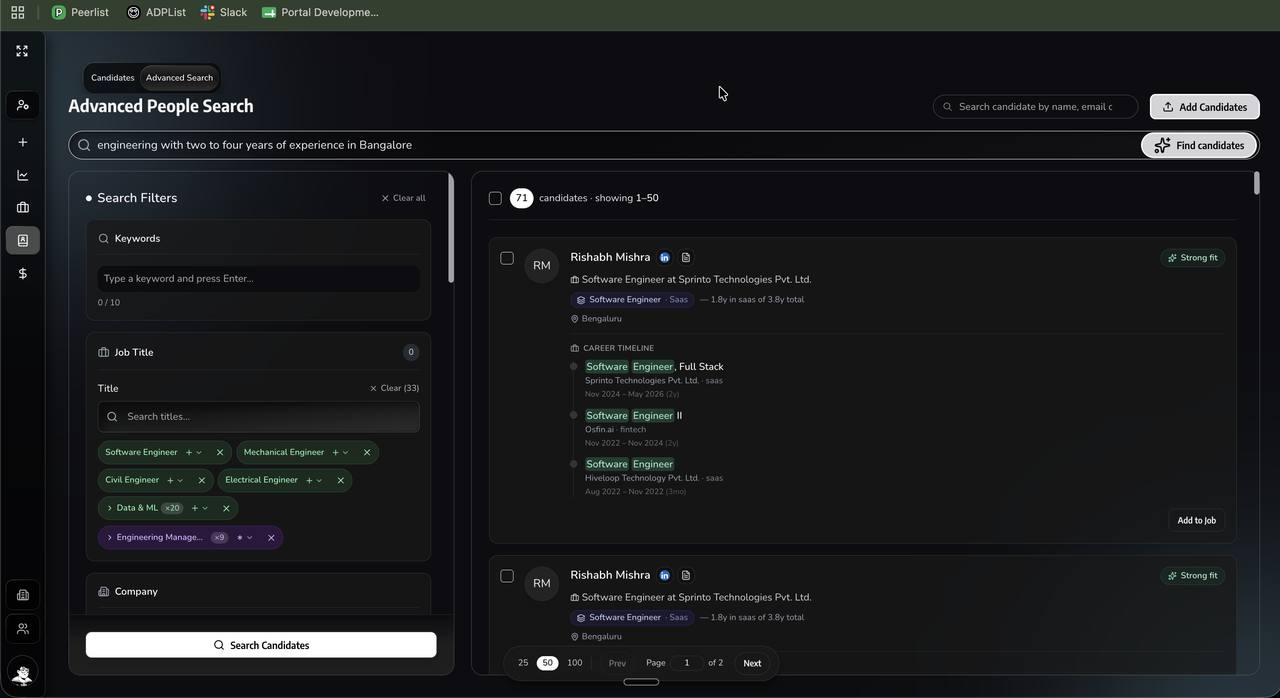
An AI-native ATS and CRM with full front and back office. Plain-language search across your own database, AI voice and video screening against criteria generated from the job description, an AI notetaker on client and candidate calls, multichannel outbound campaigns, pay-and-bill, timesheets and invoicing, and 400+ pre-built integrations with an open read-write API.
A pool search on a volume role surfaces around 1,200 relevant profiles, narrows to a ranked 300 contacted in parallel across call, WhatsApp and email, and produces roughly 10 submission-ready profiles in hours. On a high-volume QA requirement we submitted 120 profiles in a single day. Customers include firms of 400+ employees.
Migration takes two weeks with notes, calls, attachments and submission history carried across, and implementation, migration, training and any gap-filling customisation are included in the licence rather than quoted separately.
Where it is not the answer: if you renewed a multi-year agreement last quarter, or your team went live on something else in the last twelve months, the switching economics work better at your next renewal.
2. Ceipal
Best for: US IT contract staffing with heavy compliance administration
A complete but conventional ATS and CRM built around US contract staffing compliance. Everything is present and everything is manual, with a simple action often taking many clicks.
Watch for: Pricing is not published across tiers. Firms consistently describe both the interface and the migration off it as painful, and search results depend heavily on how precisely a query was built.
3. Bullhorn
Best for: enterprise firms already committed to its ecosystem
The category incumbent since 1999, running more than 10,000 agencies. Assembled through a dozen acquisitions: Herefish became Bullhorn Automation, cube19 became Bullhorn Analytics, Textkernel and SourceBreaker became Amplify Search and Match, TargetRecruit arrived in 2025.
Watch for: Starter is $99 per user per month and Core is $165. The sales CRM sits on the quote-only Pro tier, and AI search, automation, analytics, SMS and onboarding are separately quoted add-ons. $165 is where it starts, not where a working setup lands.
4. JobDiva
Best for: large US contract operations scaling through headcount
Built for large-scale US contract staffing with harvesting, VMS connectivity and back office.
Watch for: It scales by putting more recruiters on more screens. Adding volume means adding people, which is a cost line rather than a strategy.
5. Recruiterflow
Best for: agencies whose bottleneck is contacting people, not qualifying them
Multichannel outbound sequencing and workflow automation, with AI agents on its AIRA plan. It is built to get messages out at volume.
Watch for: Full AI functionality sits on the AIRA plan, so the capability most firms are comparing on depends on the tier you buy. It does not qualify anybody who replies.
6. Zoho Recruit
Best for: firms already running the Zoho suite
A general recruitment product with a free plan and deep integration across Zoho's other products.
Watch for: Staffing workflow is configuration rather than native design, and that configuration is a cost paid in setup time, maintenance and key-person risk.
7. Loxo
Best for: executive search desks sourcing into cold markets
A large external profile database with contact data built into the ATS and CRM, so sourcing and pipeline sit in one subscription.
Watch for: The database is rented. Profiles surfaced through it belong to Loxo, not to you, and none of it transfers when you leave. Basic is reported around $169 per user per month.
How to choose between them
If you are staffing US-headquartered GCCs on contract, Ceipal and Bullhorn understand that model, at Western prices with AI quoted separately.
If your mandates are volume-heavy, JobDiva scales, by adding recruiters.
If you need niche technical search, Loxo's rented database has a case on genuinely cold roles.
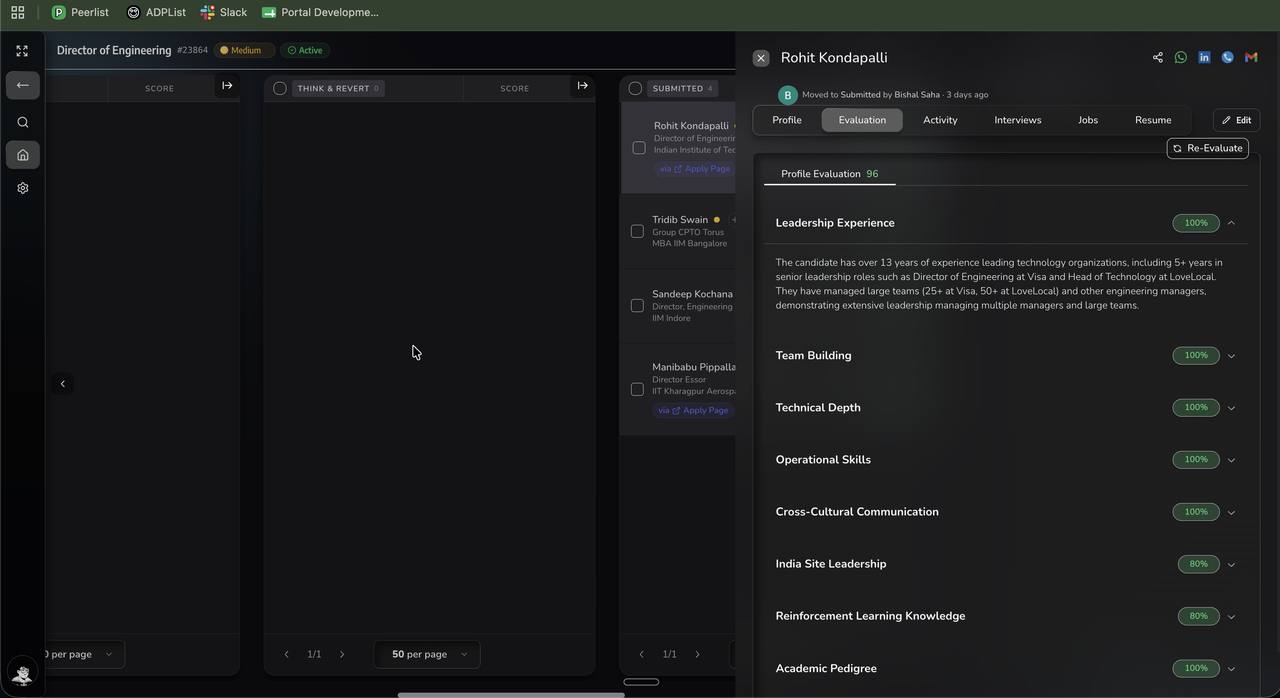
If your mandates are both high volume and specific, which is the normal GCC shape, you need generated evaluation criteria that adapt per role and screening that runs without a recruiter dialling. Sortinghat does both, with data hosted in your own country.
How to compare cost properly
The licence line is the least useful number in this category. Six costs decide what a platform actually costs over three years.
| Cost line | On the quote? | How it behaves |
|---|---|---|
| Licence | Yes | Seats times tier price, plus renewal escalation |
| Implementation | Sometimes | One-off, often via a partner. Included with Sortinghat. |
| Migration | Rarely | Vendor fee plus your team's hours. Included with Sortinghat. |
| Modules to reach a working setup | No | Where quotes diverge most between vendors |
| Recruiter hours | No | The largest line by far, and the one nobody models |
| Job portal spend | No | Does it reduce it? One firm went from $100 a role to $60 |
The last two lines are usually larger than the first four combined. A platform that removes an hour a day from every recruiter is not comparable to one that costs slightly less per seat, and comparing only the licence is how firms end up paying more for less.
What to test before you shortlist anything
Five checks that separate a real evaluation from a feature tour. Run them on every platform with your own data rather than the vendor's demo database.
- Search your own database in plain English. Describe someone you actually placed and see whether they appear in the top twenty.
- Open a candidate score and ask why. A number with no reasoning behind it is a number your recruiters will ignore.
- Look at one candidate contacted on three channels. One timeline, or three separate logs?
- Ask for the all-in price, including every module you would actually license, then ask what it renews at.
- Ask for the migration plan in writing, with anything that will not carry across named explicitly.
Three questions that decide it faster than any comparison table
Shortlists inform the decision. These three make it, and all of them are about your firm rather than any platform.
What is capping your revenue?
Not what is annoying, what is capping revenue. If your recruiters cannot carry more roles, the answer is throughput, and throughput comes from removing manual sourcing and screening rather than from better record keeping. Firms routinely buy for the annoyance and change nothing.
What happens to the team in week one?
The most common failure in this category is not a bad platform. It is a good platform nobody switched to. Ask every vendor what happens in week one, week four and week twelve, who runs the migration, and what it costs. A vague answer is the answer.
What is the number at year three?
Licence plus implementation plus migration plus every module needed to reach a working setup plus renewal escalation, minus what the platform removes from recruiter hours and job portal spend. Vendors who will only discuss the per-seat headline are telling you something about the other five lines.
Frequently asked questions
What is a GCC and why does it matter to staffing firms?
A global capability centre is an offshore unit a multinational operates directly rather than outsourcing. India hosts 2,117 of them across 3,728 units, employing roughly 2.36 million people, which makes them one of the largest and fastest-growing sources of hiring demand in the country.
How is GCC hiring different from IT staffing?
Volumes are higher, skill requirements are more specific, the stakeholder count is larger and reporting expectations come from a multinational parent. Most platforms handle volume or specificity, not both at once.
Which recruitment software suits GCC hiring partners?
One that generates evaluation criteria per role rather than using a static scorecard, screens at volume without a recruiter dialling, and hosts data where the client's parent expects it.
Where should GCC candidate data be hosted?
In the client's own country, which is what Sortinghat does. A multinational parent typically asks this before it asks what the platform does, so confirm it with any vendor you shortlist.
Can one platform handle both volume and niche GCC roles?
It requires criteria that adapt per role. Sortinghat generates weighted evaluation criteria from each job description, so the same candidate scores differently for the same title at two different clients.
How fast can a GCC mandate be staffed?
On a volume requirement, a pool search surfaces around 1,200 relevant profiles, narrows to a ranked 300 contacted in parallel, and produces roughly 10 submission-ready profiles in hours. On a high-volume QA requirement we submitted 120 profiles in a single day.
Bottom line
GCC hiring is the fastest-growing segment in Indian recruitment and almost no platform is built for the firms serving it. The requirement is volume and specificity together, reporting a multinational parent will accept, and data hosted where the client expects. Sortinghat generates weighted evaluation criteria per role, screens with AI voice and video calls at volume, threads WhatsApp and Naukri natively, hosts data in the client's own country, and carries full front and back office with 400+ pre-built integrations.
See it running on your own data
Bring a live role and a sample of your database. We will run the search, build the scorecard and show you the shortlist against your own criteria.
Book a demoFounder of Sortinghat, an AI-native ATS and CRM for staffing, search and RPO firms. Writes about recruiter capacity, sourcing economics and what actually changes when AI reaches a delivery desk. More about the author
Related reading