Healthcare Staffing: What Makes It Structurally Different
Credentialing is not paperwork on top of recruitment. It is the operation, and everything else is arranged around it.
In most staffing, compliance is a check before a start date. In healthcare it is the constraint the entire desk runs on. A candidate without a current registration, a verified qualification and an in-date clearance cannot work, regardless of how good they are or how urgently the shift needs covering. That single fact reorders sourcing, screening, scheduling and the software you need.
Last reviewed August 2026. Delivery observations from Sortinghat customer base, stated as directional.
Key takeaways
- Credentialing is the operation, not an administrative step. An expired document is a worker who cannot be placed, however available they are.
- Documents expire, which makes the database a live object. A compliant worker in March may be non-compliant in June with no action taken.
- Shift patterns break standard availability models. Availability is not a yes or no; it is a pattern across days, nights and weekends.
- Client-side rules vary per site. Two hospitals with the same requirement will have different induction and clearance rules.
Why credentialing reorders everything
A general staffing desk sources, screens, submits and then handles compliance. A healthcare desk cannot, because a candidate who fails credentialing was never placeable and the sourcing effort was wasted.
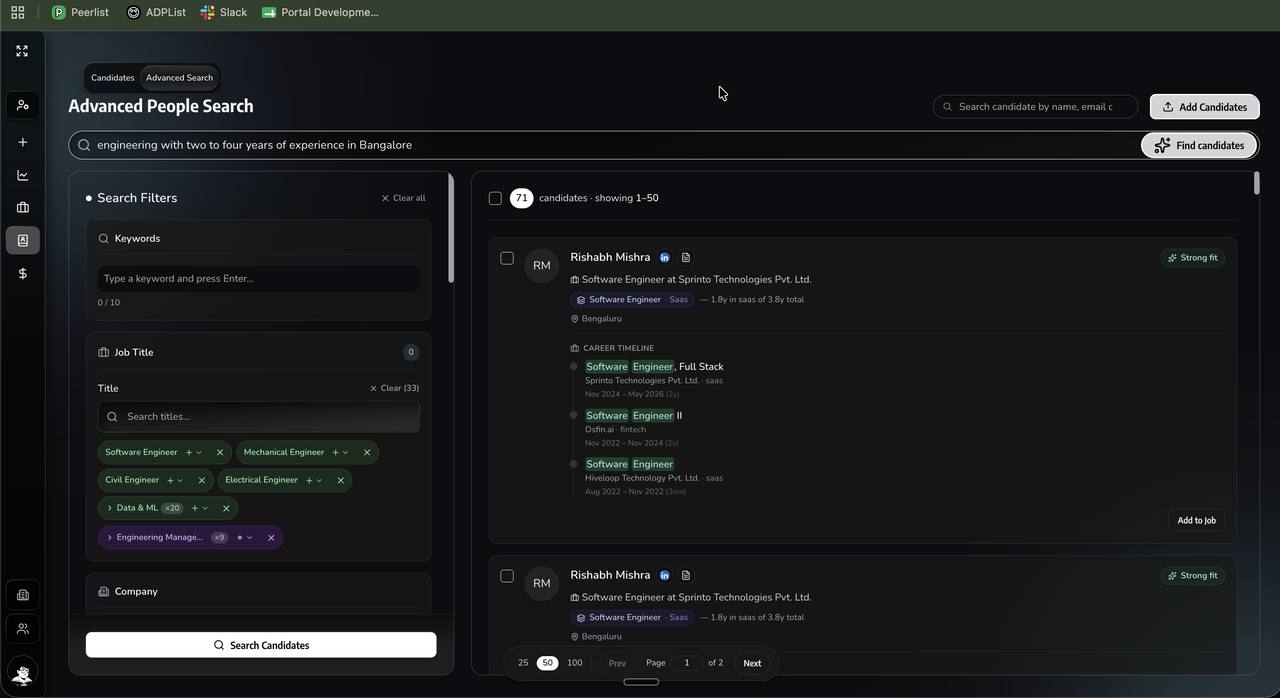
So the sequence inverts. Compliance status becomes a filter applied at search time rather than a check applied before start. A search that returns fifty nurses is useless if only twelve hold current registration for that setting.
That requires the compliance state to live on the candidate record as structured data with expiry dates attached, rather than as attachments somebody opens to check.
Documents expire, and that changes the database
In most recruitment, a verified fact stays verified. A degree obtained in 2019 is still obtained.
Healthcare credentials expire: registrations renew, clearances lapse, mandatory training has a validity window. A worker who was fully compliant in March may be unplaceable in June without anyone doing anything wrong.
That makes the database a live object requiring continuous maintenance rather than periodic cleanup. The practical requirement is expiry-driven alerts that surface a worker before the document lapses, not a report somebody runs quarterly and acts on late.
Availability as a pattern, not a state
On a professional desk, availability is broadly binary. On a shift desk it is a pattern: which days, which shift types, how far somebody will travel, whether they will take nights.
Matching against that pattern is a different problem from matching against a skill. Two workers with identical qualifications are not interchangeable if one will not work weekends and the shift is Saturday.
This shares more with temp and light industrial delivery than with professional recruitment, including the fact that availability decays in days rather than weeks and needs re-confirming at volume.
Client rules vary per site
Two hospitals in the same city, hiring the same role, will frequently have different induction requirements, different clearance thresholds and different documentation.
A single global compliance checklist therefore fails. What is needed is per-client requirement sets, so that a worker compliant for one site is correctly shown as not yet compliant for another, rather than appearing available and being rejected at the door.
That is a configuration requirement rather than a feature, and it is close to how RPO accounts need per-client configuration.
What this means for the software
Four requirements that a general ATS typically does not meet.
Compliance as structured data with expiry. Not attachments. Fields with dates that can be searched and alerted on.
Search filtered by current compliance. So a shortlist is placeable rather than theoretical.
Availability as a pattern. Days, shift types and travel radius, re-confirmed at volume.
Per-client requirement sets. Because a worker is compliant for a site rather than compliant in general.
What does not change
Redeployment is still the cheapest placement. A worker finishing an assignment is already credentialed for that client, which makes moving them the highest-margin action available.
Speed still decides fill rate. An unfilled shift is unrecoverable revenue, exactly as in any shift-based desk.
The relationship still holds the account. Compliance is table stakes. Reliability is what gets renewed.
Five checks worth running on your own desk
Everything above is context. These five turn it into something you can act on, and each takes under an hour.
1. Where did your last twenty placements come from?
Split them by source: your own database, a job portal, a referral, outbound sourcing. Most firms are surprised by how much they paid a portal for people already in their records. An audit of one firm's 3 million candidates found roughly 80 percent were real people whose records had simply gone out of date, covered in the database-first audit.
2. What is your actual time from brief to shortlist?
Measured from when the client briefed you, not from when the requisition was created in your system. In contingency work the firm that submits first usually gets paid, so this is a direct predictor of fill rate. Whether that bet still works is a separate question.
3. What share of gross profit sits with your largest client?
Concentration is the most common structural weakness in a staffing firm and the one founders notice last, usually when the account moves. It is also the single biggest discount on a valuation.
4. What is your response rate by channel?
Against your own baseline rather than a published benchmark. On strong roles we see roughly 40 responses per 100 contacted by phone, 25 on WhatsApp and 12 to 15 by email, broken down in our channel benchmarks. The ordering surprises teams who assumed messaging had replaced calling.
5. How many roles can one recruiter genuinely carry?
Not how many they are assigned, how many they can work properly. A recruiter running manual screening manages around 40 calls a day and finds three or four people worth submitting. That is the ceiling, and every growth plan sits on top of it. Filtering before dialling changes the arithmetic.
Frequently asked questions
What makes healthcare staffing different from other staffing?
Credentialing is the operating constraint rather than a final check. A worker without current registration, verified qualifications and in-date clearances cannot be placed at all, which means compliance has to filter the search rather than follow it.
Why do healthcare credentials need continuous monitoring?
Because they expire. Registrations renew, clearances lapse and mandatory training has validity windows, so a fully compliant worker in March can be unplaceable in June without anyone doing anything wrong.
How should availability be handled on a healthcare desk?
As a pattern rather than a state. Which days, which shift types, travel radius and whether the worker takes nights. Two identically qualified workers are not interchangeable if one will not work the shift being covered.
Why does compliance vary between healthcare clients?
Induction requirements, clearance thresholds and documentation differ by site, even between hospitals in the same city. A single global checklist produces workers who appear available and are turned away at the door.
What should healthcare staffing software do differently?
Hold compliance as structured data with expiry dates rather than attachments, filter search by current compliance status, model availability as a pattern, and support per-client requirement sets.
Is redeployment important in healthcare staffing?
It is the highest-margin action available, because a worker finishing an assignment is already credentialed for that client. Sourcing and credentialing costs are both avoided, which is rarely true anywhere else on the desk.
The report worth running on your compliance data
Pull every worker whose credentials expire in the next ninety days and check how many have been contacted about renewal. On most healthcare desks the answer is very few, and each one becomes an unplaceable worker on a date you already knew about.
That single list, worked weekly, protects more fill rate than any increase in sourcing.
See compliance filter your search
Bring your worker records and one live shift requirement. We will show you who is genuinely placeable today.
Book a demoFounder of Sortinghat, an AI-native ATS and CRM for staffing, search and RPO firms. Writes about recruiter capacity, sourcing economics and what actually changes when AI reaches a delivery desk. More about the author
Related reading