Job Boards Are Dying and the Industry Will Not Say It Out Loud
Every staffing firm complains about portal spend and renews anyway, because nobody has built the alternative.
Job portals still work in the narrow sense that posting a role produces applications. What has broken is the ratio between what you pay and what you get, because candidates now apply at volume with almost no effort and the resulting pile is larger and less relevant. Firms respond by paying for more visibility, which produces more of the same problem, and the budget renews because the alternative was never built.
Last reviewed August 2026. Assessment drawn from Sortinghat delivery data and customer observation.
Key takeaways
- Applications went up and relevance went down at the same time. Applying became nearly free for candidates, which changed who applies.
- Paying for visibility amplifies the problem. More reach on a broken ratio produces more unusable applications.
- The alternative is a database nobody maintained. One firm's audit found 80 percent of 3 million records were real people with stale details.
- Portal spend is the most reducible cost on a staffing P&L. One firm moved from about $100 a role to $60.
What actually broke
Not the portals. The economics of applying.
Tailoring an application used to cost a candidate twenty minutes, which limited how many roles anyone applied to and meant an application carried a signal of intent. That cost has collapsed. A candidate can now produce a version of their CV mirroring any job description in seconds.
Volume per candidate rose sharply and the intent signal disappeared, which is covered in detail in why inbound got worse. The portal did not change. What it delivers did.
Why buying more visibility makes it worse
The standard response to poor yield is to buy a better slot, a longer listing or a boosted post.
That increases reach against an unchanged ratio. More people see the role, more people apply cheaply, and the recruiter has a larger pile with the same proportion of usable candidates. The cost per usable application is roughly unchanged and the review burden has grown.
This is why portal spend rises while satisfaction falls, and why the annual renewal conversation feels worse each year without anyone being able to point at what changed.
What the alternative actually is
Not a different portal. The database you already paid to build.
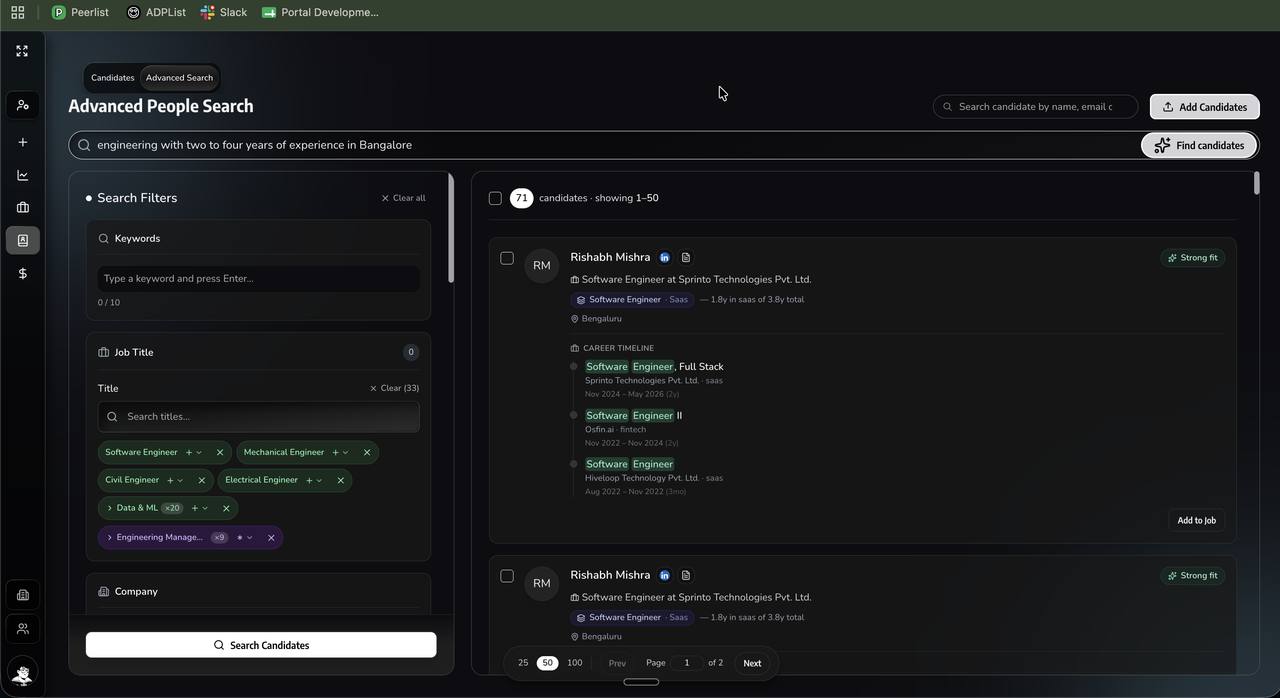
An audit of one firm's 3 million records found roughly 10 percent duplicates, 10 percent unusable and 80 percent real people whose records were simply out of date. Those people had changed jobs, which made the record wrong rather than the person irrelevant.
Making that 80 percent findable took portal spend from about $100 a role to $60. The people were already owned and the missing capability was search rather than supply, which is the argument in database-first sourcing.
Why nobody says this out loud
Three reasons, none of them conspiratorial.
The spend is budgeted. An annual portal contract is a line somebody signed off, and arguing against it is arguing against a decision already made.
It still works occasionally. Roles do get filled from portals, which makes the case for cancelling harder than the case for continuing.
The alternative requires work first. A database is only cheaper than a portal if it is searchable, and getting there takes a migration and a habit change before it takes any saving.
What to actually do about the budget
Not cancel it. Four steps in order.
Measure cost per usable application, not per application. Most firms track the wrong denominator and the number looks acceptable.
Check your last twenty placements by source. Firms are consistently surprised by how many were already in their own records before they paid to source them.
Make the database searchable before you cut anything. Cutting spend without an alternative produces a fill rate problem in six weeks.
Then reduce deliberately, by role type. Portals remain reasonable for genuinely fresh supply and poor value for roles your database already holds.
Five checks worth running on your own desk
Everything above is context. These five turn it into something you can act on, and each takes under an hour.
1. Where did your last twenty placements come from?
Split them by source: your own database, a job portal, a referral, outbound sourcing. Most firms are surprised by how much they paid a portal for people already in their records. An audit of one firm's 3 million candidates found roughly 80 percent were real people whose records had simply gone out of date, covered in the database-first audit.
2. What is your actual time from brief to shortlist?
Measured from when the client briefed you, not from when the requisition was created in your system. In contingency work the firm that submits first usually gets paid, so this is a direct predictor of fill rate. Whether that bet still works is a separate question.
3. What share of gross profit sits with your largest client?
Concentration is the most common structural weakness in a staffing firm and the one founders notice last, usually when the account moves. It is also the single biggest discount on a valuation.
4. What is your response rate by channel?
Against your own baseline rather than a published benchmark. On strong roles we see roughly 40 responses per 100 contacted by phone, 25 on WhatsApp and 12 to 15 by email, broken down in our channel benchmarks. The ordering surprises teams who assumed messaging had replaced calling.
5. How many roles can one recruiter genuinely carry?
Not how many they are assigned, how many they can work properly. A recruiter running manual screening manages around 40 calls a day and finds three or four people worth submitting. That is the ceiling, and every growth plan sits on top of it. Filtering before dialling changes the arithmetic.
Frequently asked questions
Are job boards still worth it for staffing firms?
They still produce applications, but the ratio between spend and usable candidates has worsened because applying became nearly free. They remain reasonable for genuinely fresh supply and poor value for roles an existing database already covers.
Why has job board quality declined?
Because tailoring an application collapsed from a twenty-minute task to seconds. Volume per candidate rose sharply and the intent signal that a tailored application used to carry disappeared entirely.
Does paying for more job board visibility help?
It increases reach against an unchanged ratio, so it produces more applications with the same proportion of usable candidates. Cost per usable application stays roughly flat while the review burden grows.
What is the alternative to job boards?
The database a firm already paid to build. An audit of one firm's 3 million records found roughly 80 percent were real people with out-of-date details, and making them findable took portal spend from about $100 a role to $60.
Should staffing firms cancel their job portal contracts?
Not before the alternative works. Cutting spend without a searchable database produces a fill rate problem within weeks. Make the database usable first, then reduce deliberately by role type.
How should portal spend be measured?
By cost per usable application rather than cost per application. Most firms track the wrong denominator, which is why the number looks acceptable while recruiters describe the applications as unusable.
The number that settles the argument
Take your last twenty placements and mark which of those people were already somewhere in your database before you started the search. Then divide your annual portal spend by the number of placements that genuinely required it.
That figure is what you are actually paying for fresh supply, and on most desks it is high enough that nobody has ever calculated it deliberately.
See what your database already holds
Bring a live role and a sample of your records. We will show you what you would have paid a portal to find.
Book a demoFounder of Sortinghat, an AI-native ATS and CRM for staffing, search and RPO firms. Writes about recruiter capacity, sourcing economics and what actually changes when AI reaches a delivery desk. More about the author
Related reading