How AI Changed Sourcing: From Three Qualified Candidates a Day to Thirty
Sourcing was never limited by how fast recruiters could work. It was limited by how much unqualified work they had to do first.
A recruiter sourcing manually makes around 40 calls in a full day and finds three or four people worth submitting. The other 36 conversations were spent discovering that somebody was ineligible, unavailable or uninterested. That discovery is the work, and it is the part that never scaled. What changed is not the speed of the calling. It is that the filtering now happens before anyone picks up a phone.
Last reviewed July 2026. Throughput figures from Sortinghat delivery data, stated as directional.
Key takeaways
- The ceiling was never dialling speed. 40 calls a day producing three or four submissions is a qualification problem, not an effort problem.
- Filtering before contact changes the arithmetic. A pool search on a volume role surfaces around 1,200 relevant profiles and narrows to a ranked 300.
- Your own database is the cheapest source you have. An audit of 3 million records found roughly 80 percent were real people whose records were out of date.
- Sourcing volume is not the metric that improved. Evidenced submissions are. A day producing 300 conversations and four usable candidates is still a bad day.
What manual sourcing actually spends its time on
Watch a manual sourcing day and the pattern is consistent. The recruiter starts from a list pulled fresh that morning, usually from a job portal. Most calls do not connect. Of those that do, a large share end inside ninety seconds because the person has moved role, is not looking, sits outside the band, or is in the wrong location.
The conversations that matter are the handful where somebody is eligible and interested. Those take ten to fifteen minutes. The other 36 calls were a filter being applied one person at a time by the most expensive resource in the building.
Dialling faster does not help, because more calls produce unqualified conversations in the same proportion. That is why headcount was historically the only lever.
What changes when filtering happens first
The alternative is to spend the filtering effort before the calling starts.
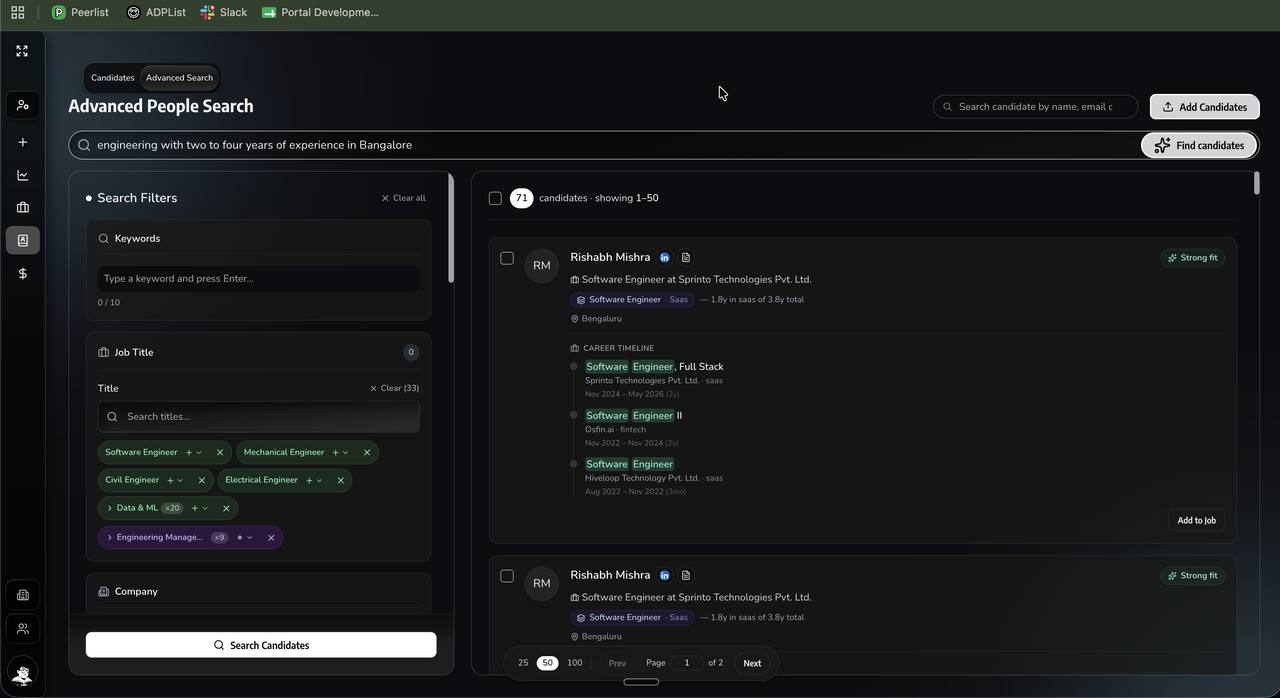
A search across the firm's own pool returns the profiles that plausibly match, and how many depends entirely on the depth of that pool. On a typical volume role that surfaces around 1,200 relevant profiles. Those get ranked against the role's criteria, and the top 300 are contacted across call, email and WhatsApp in parallel rather than sequentially.
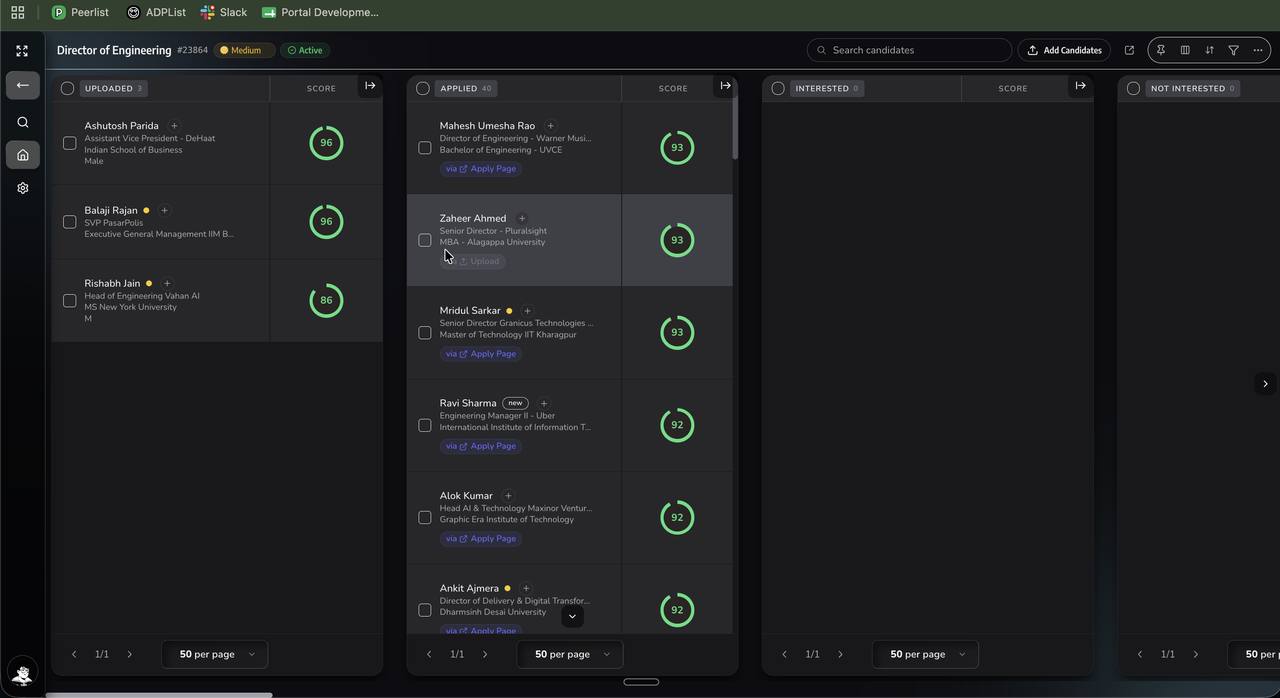
The output within a few hours is roughly 10 submission-ready profiles, each with availability, compensation and the role-specific claims already confirmed. On a high-volume QA requirement we submitted 120 profiles in one day.
The number that matters there is not 300. It is that the 300 were chosen before anyone spoke to them.
Why the database matters more than the reach
The instinct when sourcing gets hard is to buy more reach: another licence, another database, another list.
An audit of one firm's 3 million records found roughly 10 percent duplicates, 10 percent unusable, and 80 percent real people whose records were simply out of date. Those 80 percent had changed jobs, which makes the record wrong rather than the person irrelevant.
Making that group findable took job portal spend from about $100 a role to $60. The people were already owned. What was missing was the ability to find them, which is a search problem rather than a supply problem.
What the recruiter does instead
Not dialling. Reading, deciding and moving people.
Results arrive continuously, and each one is a small decision: advance, reject, flag for a human call, or return to the pool with a logged reason. A recruiter working well does this in under a minute per result.
The second thing they do is take the conversations that need a person. A strong candidate on a competitive role needs selling rather than qualifying, and that should never be automated.
The failure mode is a recruiter who starts reading full transcripts, which turns triage into review and collapses throughput by mid-morning.
Where AI sourcing still fails
Three honest limits.
A shallow pool. If the search returns 40 profiles rather than 1,200, you are not doing volume sourcing. You are doing normal sourcing with extra software, and saying so is more useful than pretending otherwise.
A badly defined brief. Screening 300 people against the wrong criteria reaches the wrong answer faster, and the speed makes it worse.
Senior and confidential roles. The first conversation is persuasion. Running it at volume tells the candidate the role is not serious, and they are not wrong.
What this changes on a staffing desk
Market analysis is only useful if it changes something on Monday. Four practical consequences that follow from everything above.
Your prospect list is probably built from history
Most staffing firms sell to the accounts they already know, which means the client list reflects where demand was five years ago rather than where it is now. Rebuilding a prospect list against current hiring activity rather than past relationships is unglamorous and it is usually the highest-return week a founder can spend.
Speed matters more than it used to
In contingency and RPO, the firm that submits first usually gets paid. A recruiter working manually manages around 40 calls a day and finds three or four people worth submitting. Filtering before dialling changes that arithmetic: a pool search on a volume role surfaces around 1,200 relevant profiles, narrows to a ranked 300 contacted across call, WhatsApp and email in parallel, and produces roughly 10 submission-ready profiles in hours.
Your own database is the cheapest source you have
An audit of one firm's 3 million records found roughly 10 percent duplicates, 10 percent unusable and 80 percent real people whose records were simply out of date. Making that 80 percent findable took job portal spend from about $100 a role to $60. Most firms are paying to source strangers while sitting on people who already know them.
Definition beats effort
Most wasted submissions are a briefing failure that surfaced three weeks later, not a sourcing failure. Generating weighted evaluation criteria from the job description, and agreeing them with the client before the search starts, removes more waste than any increase in activity.
Frequently asked questions
How many candidates can a recruiter source in a day?
Manually, around 40 calls producing three or four people worth submitting on a good day. The ceiling is qualification rather than dialling speed, because most of those conversations end within ninety seconds once eligibility is checked.
How does AI sourcing actually work?
By filtering before contacting rather than during. A search across the firm's own database surfaces the profiles that plausibly match, ranks them against the role's criteria, and contacts a shortlist across multiple channels in parallel rather than sequentially.
Does AI sourcing replace recruiters?
It replaces the part of the day spent discovering that someone is ineligible. The recruiter moves to triage and to the conversations that require selling rather than qualifying, which is where their judgement changes the outcome.
Is a bigger candidate database better?
Only if it is searchable. An audit of one firm's 3 million records found roughly 80 percent were real people with out-of-date records. Making them findable took job portal spend from around $100 a role to $60.
What should you measure on a sourcing desk?
Evidenced submissions produced, not calls made or profiles sourced. A day generating 300 conversations and four usable candidates is a bad day with impressive activity metrics.
When does AI sourcing not work?
When the database is too shallow to return a meaningful result set, when the brief is poorly defined so the criteria are wrong, and on senior or confidential roles where the first conversation is a sell rather than a qualification.
The test worth running on your own desk
Take your last ten filled roles and check how many of those people were already somewhere in your database before the search started. Most firms find the answer is higher than they expected, which means they paid to source people they already owned.
Then run one of those roles as a plain-language search against your own records and see whether the person you eventually placed appears near the top. That is the only benchmark that matters, because you already know the right answer.
See what your own pool returns
Bring one live role and a sample of your database. We will run the search and show you the depth you already have.
Book a demoFounder of Sortinghat, an AI-native ATS and CRM for staffing, search and RPO firms. Writes about recruiter capacity, sourcing economics and what actually changes when AI reaches a delivery desk. More about the author
Related reading