Sortinghat vs Recruiterflow: The 2026 Comparison for Growing Recruitment Agencies
Recruiterflow is strong at getting people contacted. Sortinghat is built for everything that happens after they reply, and it does not put the AI behind a separate plan.
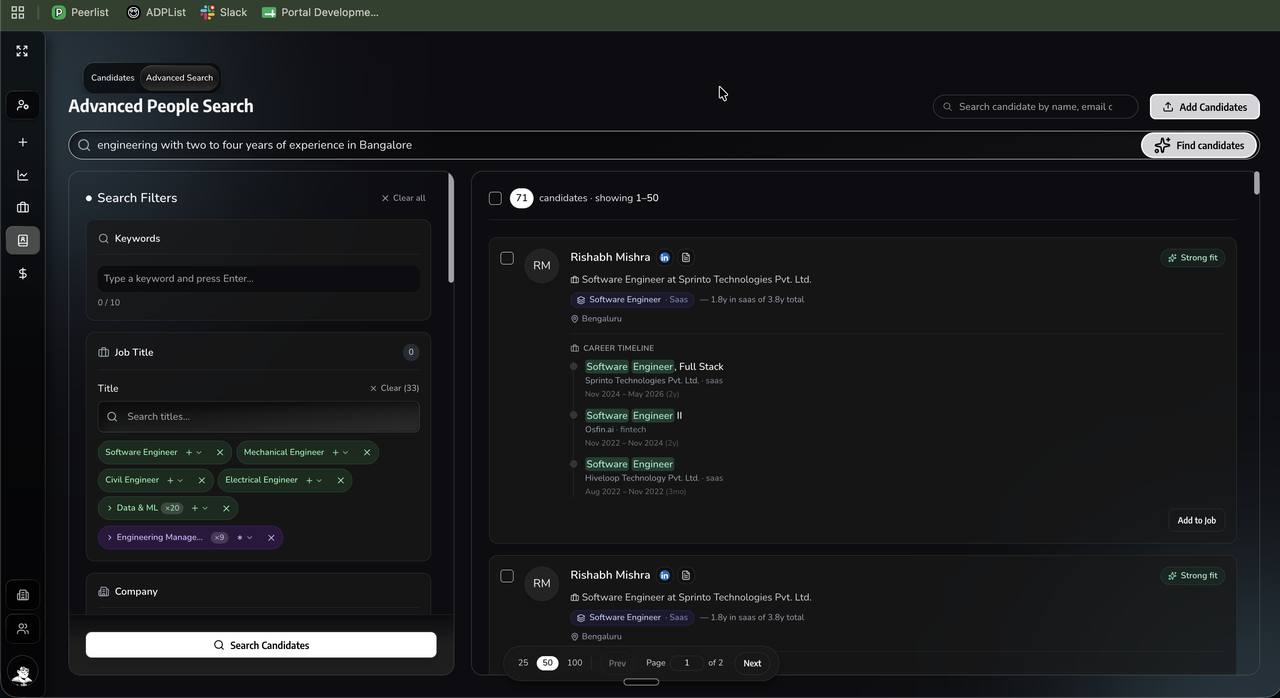
Recruiterflow sends messages. That is the product. What it does not do is qualify anybody who replies to them. Sequencing gets a candidate to reply. A recruiter still has to call them, verify the CV, confirm the notice period and decide whether they are worth submitting. That work is the ceiling on a desk, and it is what Sortinghat automates.
Last reviewed June 2026. Recruiterflow information taken from its published pricing and product documentation.
Key takeaways
- Recruiterflow gates its full AI behind the AIRA plan. Sortinghat includes voice screening, video interviews, the interview assistant, evaluation and natural language search in the platform.
- Sequencing solves contact. It does not solve qualification. A recruiter running manual screening manages around 40 calls a day and finds three or four people worth submitting.
- Sortinghat runs both halves. Multichannel campaigns across call, WhatsApp and email, then AI screening against the role's weighted criteria, producing around 10 submission-ready profiles in hours.
- Migration takes two weeks and nothing is left behind. Notes, call history, attachments and submission history all carry across, and anything your desk needs that is missing gets built during the migration rather than added to a roadmap.
Contacting people versus qualifying them
Recruiterflow's approach. Multichannel outreach sequences and workflow automation, with AI agents on its AIRA plan. It is good at volume of contact and the automation primitives are mature.
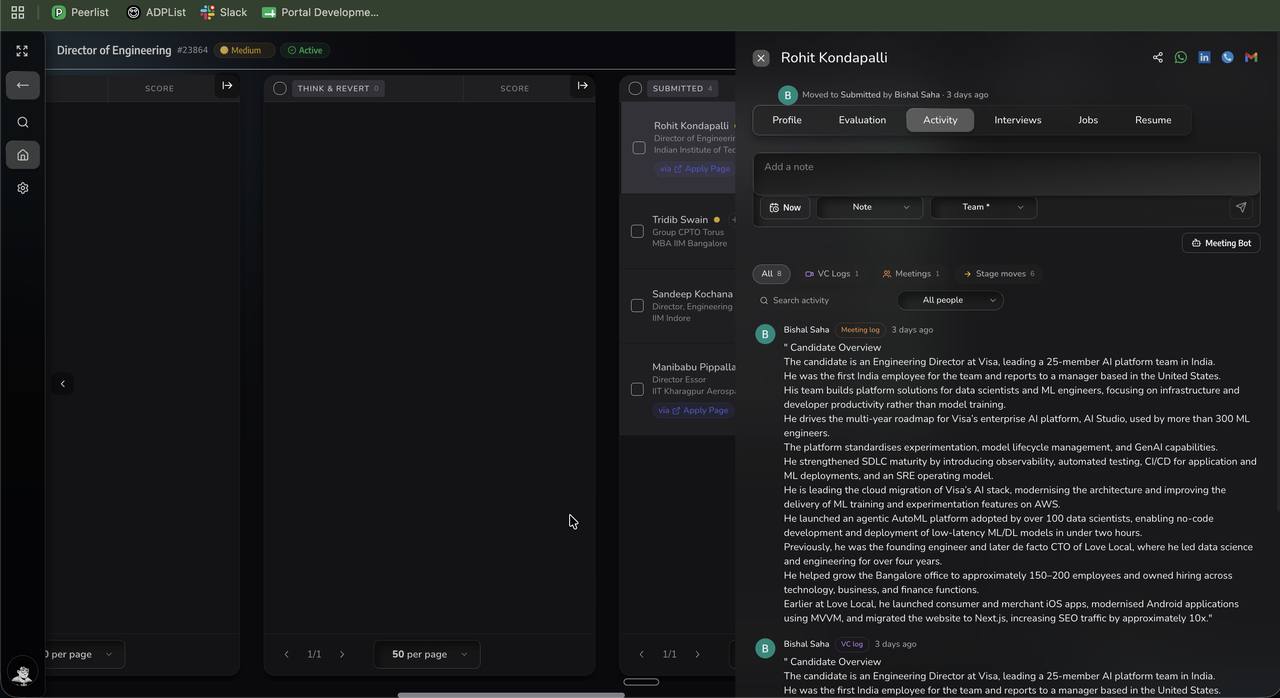
Sortinghat's approach. Outreach is the first half. The platform then makes the screening calls, runs video interviews, evaluates candidates against criteria generated from the job description, and writes the notes onto the record. The recruiter picks up a ranked shortlist with notice period, compensation and CV claims already confirmed.
If your recruiters are contacting plenty of people and cannot process the replies, sequencing is not your constraint.
Sortinghat vs Recruiterflow at a glance
| Category | Recruiterflow | Sortinghat |
|---|---|---|
| Outbound sequencing | Strong, multichannel | Multichannel: call, WhatsApp, email, native |
| AI voice screening | Not native | Native, 70% completion, 3 to 7 minutes |
| AI video interviews | Not native | Native |
| AI availability | Full functionality on the AIRA plan | In the platform, no separate tier |
| Search | Filtering and keyword | Plain language, ranked, explainable |
| Evaluation | Standard scoring | Weighted criteria generated from the job description |
| Back office | Front office focused | Full front and back office, pay-and-bill, timesheets, invoicing |
| India channels | Limited | Native Naukri and WhatsApp threading |
| Integrations | Established set | 400+ pre-built, plus open read-write API |
| Implementation | Self-serve to guided | Two weeks, included, gaps built during migration |
Rows two and three are the difference. Both platforms will get a candidate to reply. Only one of them qualifies the reply without a recruiter picking up the phone.
Where the two platforms actually differ
What happens after the candidate replies
Recruiterflow. The reply lands in a shared inbox and a recruiter takes it from there: the call, the verification, the notes, the stage update. Automation moves the message, not the work.
Sortinghat. AI voice or video screening runs against the role's criteria, confirms interest, availability and compensation, tests the CV claims that decide the submission, and writes structured fields onto the record. A shortlist of roughly 300 contacted in parallel produces around 10 submission-ready profiles in hours.
Bottom line: Sequencing ends where the work begins. Sortinghat carries it through to a client-ready shortlist.
Whether the AI is included
Recruiterflow. Full AI functionality sits on the AIRA plan, so the capability most firms are comparing platforms on in 2026 depends on which tier you buy.
Sortinghat. Voice screening, video interviews, the interview assistant, generated evaluation criteria, natural language search and the AI notetaker are part of the platform rather than a tier above it.
Bottom line: Compare the tier you would actually buy, not the entry headline. That is where the real cost difference between these two platforms appears.
Reporting and desk economics
Recruiterflow. Reporting covers pipeline and activity. Connecting recruiter activity to desk margin usually means exporting and rebuilding it outside the platform.
Sortinghat. Desk margin, recruiter capacity and pipeline forecasting sit in the same workspace as the data they measure. A founder sees which desks are profitable without a spreadsheet in between.
Bottom line: Reporting activity is not the same as knowing what it earned.
Adoption, which is where most rollouts fail
Recruiterflow. Implementation is self-serve or guided. Whether the team adopts it is left to the team.
Sortinghat. Implementation, migration, training and any gap-filling customisation are included in the licence. If your desk depends on something the platform does not have, we build it inside the migration window rather than logging it on a roadmap.
Bottom line: The most common failure in this category is not a bad platform. It is a good one nobody switched to.
Running an India desk
Recruiterflow. Channel coverage is built around Western markets. WhatsApp is not natively threaded to the candidate record.
Sortinghat. Naukri and WhatsApp are native. Threads attach automatically, so the conversation history belongs to the firm rather than to the recruiter's phone when they leave.
Bottom line: For any firm with an India delivery team this changes the daily experience more than any single AI feature.
What each platform actually costs to run
Recruiterflow publishes tiered pricing with full AI functionality on its AIRA plan. Confirm whether the AI you are evaluating is included at the tier you would actually buy, because that is where quotes between these two platforms diverge.
The licence is rarely the largest line. Six costs decide what a platform actually costs over three years:
| Cost line | On the quote? | How it behaves |
|---|---|---|
| Licence | Yes | Seats times tier price, plus renewal escalation |
| Implementation | Sometimes | One-off, often via a partner. Included with Sortinghat. |
| Migration | Rarely | Vendor fee plus your team's hours. Included with Sortinghat. |
| Modules to reach a working setup | No | Where quotes diverge most between vendors |
| Recruiter hours | No | The largest line by far, and the one nobody models |
| Job portal spend | No | Does it reduce it? One firm went from $100 a role to $60 |
The last two lines are usually larger than the first four combined. A platform that removes an hour a day from every recruiter is not comparable to one that costs slightly less per seat.
What Sortinghat does that Recruiterflow does not
AI is in the platform, not on the invoice
Voice screening, video interviews, the AI interview assistant, evaluation against weighted criteria, natural language search and the notetaker are all part of the platform. There is no AI tier, no separate contract and no account manager conversation before you can use them.
Search is a sentence, not a Boolean string
Describe the person you want and get a ranked result. Compound conditions that never appear as keywords, institution tier, company stage, domain depth, resolve without anyone building a query. Sourcers are productive in a session rather than a quarter.
Screening runs at enterprise volume
A pool search on a volume role surfaces around 1,200 relevant profiles, narrows to a ranked 300, and contacts them by call, WhatsApp and email in parallel. That produces roughly 10 submission-ready profiles in hours. On a high-volume QA requirement we submitted 120 profiles in a single day.
Full front and back office
Timesheets, invoicing and pay-and-bill alongside the ATS and CRM, with client-specific formats built to your requirement rather than configured around.
400+ pre-built integrations
Job portals, messaging, calendar, assessment, interview and finance systems, plus an open read-write API for everything else.
Migration in two weeks, and gaps get built
Notes, call history, attachments and submission history carry across. If your desk depends on something the platform does not have yet, we build it inside the migration window rather than logging it on a roadmap. Implementation, migration, training and that customisation are included.
Built for firms running at scale
Our customers include firms of 400+ employees. The platform is designed for enterprise staffing volume rather than scaled down from it.
Switching from Recruiterflow: what it takes
We have run Recruiterflow migrations. The data model is modern, which makes extraction cleaner than most.
- Sequence engagement history. Verify it arrives threaded to the person rather than as a flat activity log.
- Custom pipelines. Agencies configure stages heavily. We map deliberately rather than accepting a default.
- Automation rules do not transfer. We document what is running before the move and rebuild the ones that matter.
- Notes, calls, attachments and submission history all carry across, validated with your team before sign-off.
Our migrations run in two weeks. Week one is export, field mapping and validation while your team keeps billing. Week two is your own environment, your team's specifics and full validation before anyone signs off. Go-live is a final export and cutover with no downtime. Implementation, migration, training and any customisation your desk needs are included rather than quoted as professional services.
Where Recruiterflow is still a good choice
Not every firm should switch, and these are the cases where Recruiterflow remains the better answer.
- You renewed a multi-year agreement last quarter. Switching economics work better at renewal. Note the date and revisit then.
- You went live in the last twelve months. If the team has just absorbed one implementation, another this year is a hard internal sell. Revisit at renewal.
The three questions that actually decide this
Comparison tables inform the decision. They rarely make it. Three questions do, and all three are about your firm rather than either platform.
What is capping your revenue?
Not what is annoying. What is capping revenue. If your recruiters cannot carry more roles, the answer is throughput, and throughput comes from removing manual sourcing and screening rather than from better record keeping. Firms routinely buy for the annoyance and change nothing.
What happens to the team in week one?
The most common failure in this category is not a bad platform. It is a good platform nobody switched to. Ask both vendors what happens in week one, week four and week twelve, who does the migration, and what it costs. A vague answer is the answer.
What does the all-in number look like at year three?
Licence plus implementation plus migration plus every module you have to add to reach a working setup plus renewal escalation. Then subtract what the platform removes from recruiter hours and job portal spend. Vendors who will only discuss the per-seat headline are telling you something about the other five lines.
Frequently asked questions
Does Recruiterflow have AI screening calls?
Not native voice screening of the kind Sortinghat runs. Recruiterflow offers AI agents with full functionality on its AIRA plan, focused on sequencing and workflow automation rather than making and evaluating screening calls.
How much does Recruiterflow cost?
It publishes tiered pricing with full AI functionality on the AIRA plan. Compare the tier you would actually buy rather than the entry headline, since that is where the total cost difference against alternatives appears.
What is the best Recruiterflow alternative?
For firms whose constraint is qualifying candidates rather than contacting them, Sortinghat adds native AI voice and video screening, generated evaluation criteria and natural language search, with full back office and 400+ integrations.
Can you migrate from Recruiterflow easily?
Yes. The data model is modern and extraction is clean. We handle mapping and validation, and notes, calls, attachments and submission history all carry across. Two weeks, included in the licence.
Is Sortinghat built for larger agencies?
Yes. Our customers include firms of 400+ employees, with full front and back office including pay-and-bill, timesheets and invoicing.
Does Recruiterflow work well for Indian staffing firms?
It is usable, and the constraint is channel coverage. WhatsApp is where Indian candidates actually reply, and a platform that does not thread it into the record holds an incomplete history on every candidate.
Bottom line
Recruiterflow is good at what it does, and what it does is get people contacted. If your problem is that not enough candidates are entering the funnel, buy it. If your recruiters are already contacting plenty of people and drowning in the replies, sequencing will not help, and the AI that would help is on a higher plan. Sortinghat runs both halves in one platform: multichannel outreach, then AI screening, evaluation and a ranked shortlist, with full back office and 400+ integrations underneath.
See it running on your own data
Bring a live role and a sample of your database. We will run the search, build the scorecard and show you the shortlist against your own criteria.
Book a demoFounder of Sortinghat, an AI-native ATS and CRM for staffing, search and RPO firms. Writes about recruiter capacity, sourcing economics and what actually changes when AI reaches a delivery desk. More about the author
Related reading
Sortinghat vs Recruit CRM: The 2026 Comparison for Growing Recruitment Agencies
Product Comparison 101Sortinghat vs Zoho Recruit: The 2026 Comparison for Growing Recruitment Agencies
Product Comparison 101Recruiterflow Alternatives: 7 Platforms Compared for 2026
Product Comparison 101Sortinghat vs Manatal: The 2026 Comparison for Growing Recruitment Teams